The Vibe Coding Revolution: What Happens When Everyone Can Build Software
In January 2025, Andrej Karpathy tweeted about "vibe coding" — writing software by describing what you want in natural language and letting the AI figure out the implementation. A year later, this throwaway observation has become a movement. Product managers are building internal tools over the weekend. Designers are prototyping functional apps instead of static mockups. Sales teams are creating custom CRM dashboards without filing a Jira ticket. The tools have gotten good enough — Replit Agent, Claude Code, Cursor's agent mode, Lovable, Bolt — that a motivated non-engineer can go from idea to deployed application in days, not months. This is simultaneously the most exciting and the most misunderstood trend in tech.
What Vibe Coding Actually Is
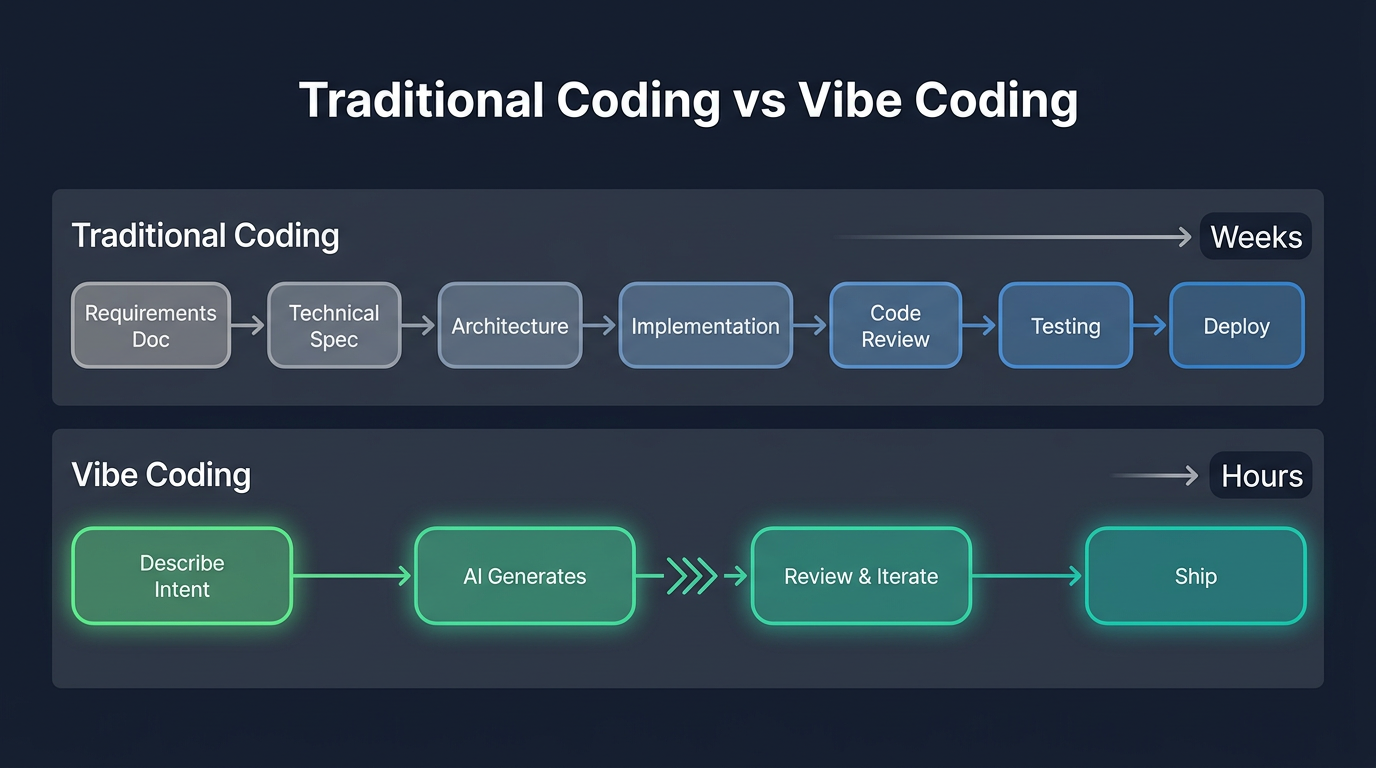
Let's be precise. Vibe coding is not "AI writes all the code." It's a development methodology where the human describes intent and the AI handles implementation details. The human says "build me a dashboard that shows customer churn by cohort with a date range filter." The AI writes the React components, the SQL queries, the API routes, and the deployment configuration. The human reviews the result, says "the chart is too small and I need an export-to-CSV button," and the AI iterates.
The critical distinction: the human maintains product vision and quality judgment. They know what the tool should do and whether it's doing it well. They don't need to know how a React component lifecycle works or how SQL window functions operate. This is a fundamental shift in who can build software, and it challenges deep assumptions about the software development process.
The Tool Landscape
The vibe coding ecosystem has matured rapidly:
- Replit Agent: Describe an app in natural language, and Replit builds it — frontend, backend, database, deployment. Best for self-contained web applications and internal tools.
- Claude Code / Cursor Agent Mode: AI coding agents that operate within a full development environment. Can read codebases, write across multiple files, run tests, and fix errors. Best for modifying existing codebases and building features within larger systems.
- Lovable / Bolt / v0: Specialized tools for building UI-heavy applications from descriptions or screenshots. Generate production-quality React/Next.js code. Best for prototyping and frontend-focused applications.
- GitHub Copilot Workspace: Takes a GitHub issue and proposes a complete implementation plan with code changes across multiple files. Best for contributing to existing open-source or internal projects.
| Tool | Best For | Skill Level | Output Quality |
|---|---|---|---|
| Cursor | Full-stack development | Developers | Production-ready |
| Replit Agent | Quick prototypes | Beginners | MVP-level |
| Claude Code | Complex projects | Intermediate | High |
| Lovable | Landing pages, apps | Non-technical | Good for demos |
| Bolt | Web applications | Beginners | Good for MVPs |
The PM's Guide to Vibe Coding
I'll be direct: if you're a product manager in 2026 and you haven't experimented with vibe coding, you're leaving leverage on the table. Here's why and how.
What PMs Should Build
- Internal tools and dashboards: That analytics view you've been waiting 3 sprints for? Build it yourself in a weekend. Connect it to your data warehouse, add the filters you need, deploy it to Vercel.
- Functional prototypes: Instead of presenting static Figma mockups to stakeholders, present a working prototype that they can click through with real (or realistic) data. The feedback quality is 10x better when people interact with a real product.
- Proof-of-concept validation: "Would customers use X?" is hard to answer with a mockup. Build X in 2 days, put it in front of 10 customers, and get real data.
- Workflow automation: That manual process where you copy data from one spreadsheet to another every Monday? Build a script that does it automatically.
What PMs Should Not Build
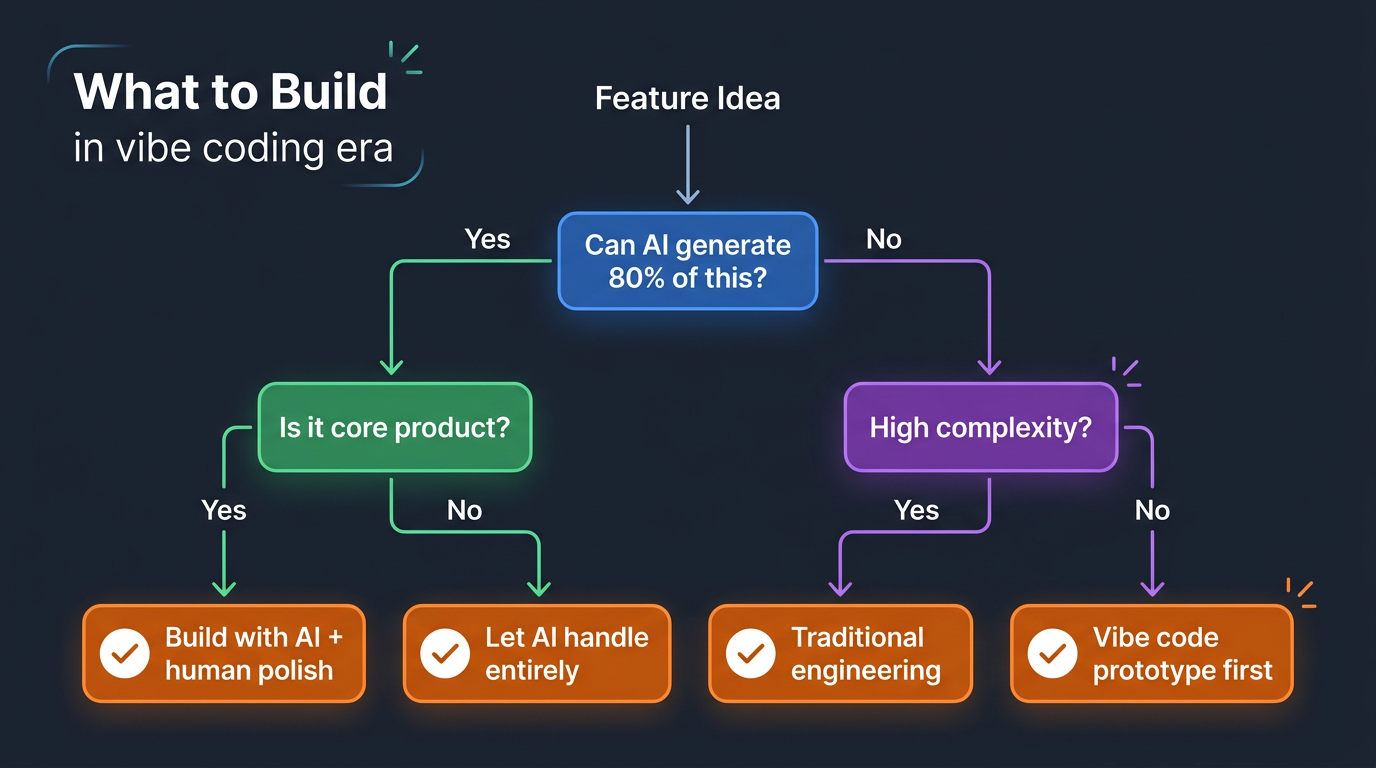
- Production features for paying customers: Vibe-coded software lacks the error handling, edge case coverage, security hardening, and performance optimization that production software requires.
- Anything touching sensitive data: If it handles PII, payment information, or health records, it needs a real engineer reviewing the security model.
- Anything that needs to scale: Vibe coding produces code that works. It doesn't produce code that works under 10,000 concurrent users.
"Vibe coding is like being able to cook a great dinner at home. It doesn't make you a restaurant chef. The skills are related but the requirements are fundamentally different." — Guillermo Rauch, CEO of Vercel
What This Means for Engineers
Let's address the elephant in the room: does vibe coding make software engineers obsolete? No. But it does change what engineers are valued for.
The New Division of Labor
Think of it this way. Building software involves a stack of concerns:
- Intent: What should the software do? (Product management)
- Design: How should it look and feel? (UX design)
- Implementation: How does it work? (Engineering — this is what vibe coding automates)
- Architecture: How does it fit into the larger system? (Senior engineering)
- Reliability: How does it handle failure? (SRE / platform engineering)
- Security: How does it resist attacks? (Security engineering)
- Performance: How does it handle scale? (Performance engineering)
Vibe coding automates the implementation layer — writing the code that translates intent into functionality. It does not automate architecture, reliability, security, or performance. These are the layers where experienced engineers create irreplaceable value.
The analogy I keep coming back to: the invention of the calculator didn't make mathematicians obsolete. It made arithmetic irrelevant as a skill and made mathematical reasoning more valuable. Vibe coding is doing the same to implementation skill. Writing a for-loop becomes irrelevant. Designing a system that handles 10M requests per day becomes more valuable.
The "Maintenance Cliff"
Here's the dirty secret of vibe coding that nobody talks about enough: the code it produces is write-only. AI-generated code often works but is poorly structured, has inconsistent patterns, and lacks the conceptual coherence that makes code maintainable. When you need to modify a vibe-coded application 6 months later, you often end up rewriting significant portions because the original code has no discernible architecture.
For throwaway prototypes and internal tools, this doesn't matter. For anything with a lifespan beyond 3 months, it matters enormously. The companies that get burned by vibe coding will be the ones that deploy vibe-coded prototypes to production and then discover that they can't maintain, extend, or debug them.
This is where engineers come in. The emerging skill is not writing code from scratch but reviewing, refactoring, and hardening AI-generated code. The engineer's role shifts from author to editor — and editing, as any writer will tell you, is the harder skill.
The Organizational Impact
Vibe coding doesn't just change individual workflows — it changes team dynamics:
The Backlog Problem Dissolves
The average product team has a 6-month backlog of "nice to have" features, internal tools, and quality-of-life improvements that never get prioritized because engineering capacity is scarce. Vibe coding lets PMs, designers, and operations teams clear this backlog themselves. The result: engineering teams can focus on the hard, high-leverage problems — architecture, scale, performance, security — while the rest of the organization handles the long tail of smaller needs.
Communication Improves
When PMs can build functional prototypes, the spec handoff problem improves dramatically. Instead of writing a 10-page PRD that the engineer interprets differently, the PM builds a working version and says, "like this, but production-quality." The engineer gets a running example of the intended behavior. Fewer misunderstandings. Fewer iterations. Faster delivery.
The "Shadow IT" Risk
The flip side: when everyone can build software, everyone will build software. Without governance, you get a proliferation of ungoverned, unmaintained, insecure internal tools that connect to production databases with hardcoded credentials. Organizations need clear policies: what can be vibe-coded and deployed? What needs engineering review? What's the process for promoting a prototype to production?
The Skills That Matter Now
Whether you're an engineer, a PM, or a designer, vibe coding changes the skill mix:
- Prompt engineering / specification: The quality of vibe-coded output is directly proportional to the clarity of the specification. People who can describe software behavior precisely — including edge cases, error states, and constraints — get dramatically better results.
- Code reading (not writing): You don't need to write React components. You do need to read AI-generated React components and spot the bug where it's not handling the loading state correctly.
- System thinking: Understanding how components interact, where state lives, how data flows — these meta-skills become more valuable when the implementation details are automated.
- Testing and validation: Knowing how to test whether software works correctly — not just on the happy path but under edge cases and failure conditions — becomes the critical quality gate.
Maintenance Cliff
Vibe-coded apps are easy to build but hard to maintain. Technical debt accrues faster without engineering discipline.
Shadow IT Explosion
Non-engineers building internal tools without IT oversight. Security and compliance gaps emerge.
Backlog Dissolution
Feature requests that sat in backlogs for months can be prototyped in hours. PMs can validate ideas instantly.
PM Superpower
Product managers who can vibe-code prototypes have an enormous advantage in stakeholder conversations.
The 5-Year Outlook
Here's my forecast for how this plays out:
- 2026-2027: Vibe coding becomes standard for prototyping and internal tools. Most product teams have at least one person using these tools regularly. Engineering teams establish governance for vibe-coded applications.
- 2027-2028: AI coding agents become reliable enough to handle production-quality code for straightforward applications (CRUD apps, dashboards, landing pages). The definition of "you need an engineer for this" narrows significantly.
- 2028-2030: The engineering profession bifurcates into "systems engineers" (who design architecture, handle scale, and ensure reliability) and "AI-augmented builders" (who use AI tools to implement features rapidly). Both roles are valued; the skill profiles are very different.
The total amount of software in the world will increase dramatically. The total number of people who can create software will increase by an order of magnitude. But the demand for senior engineers who can build reliable, secure, scalable systems will also increase — because there will be far more software that needs to be production-hardened.
Conclusion
Vibe coding is real, it's here, and it's changing the economics of software development. It lowers the barrier to creation, empowers non-engineers to build functional tools, and frees professional engineers to focus on harder problems. But it's not magic. It produces code that works, not code that's maintainable, secure, or scalable. The winners will be the teams that embrace vibe coding for what it is — a powerful tool for rapid creation — without confusing it for a replacement for engineering discipline.
Everyone can cook. Not everyone can run a kitchen.