The Return of the Monolith? Microservices Architecture in 2025
Microservices solved a scaling problem(teams) but created a complexity problem(network).In 2025, we are collectively remembering that network calls are expensive, distributed transactions are hard, and sometimes, a single binary is all you need.
The Prime Video Shockwave
In 2023, Amazon Prime Video published a case study that shook the industry.They moved from a distributed microservices architecture to a monolithic application for their audio / video monitoring service.The result ? They reduced costs by 90 %.
They realized that sending data over the network between step functions and lambda functions was notoriously expensive and slow.Moving the processing into a single process eliminated the network overhead.
The Distributed Monolith Trap
Most companies that think they have microservices actually have a "Distributed Monolith."
- The Symptom: You have to deploy 5 different services in a specific order to ship one feature.
- The Reality: You have high coupling (monolith) but with network latency (distributed). This is the worst of both worlds.
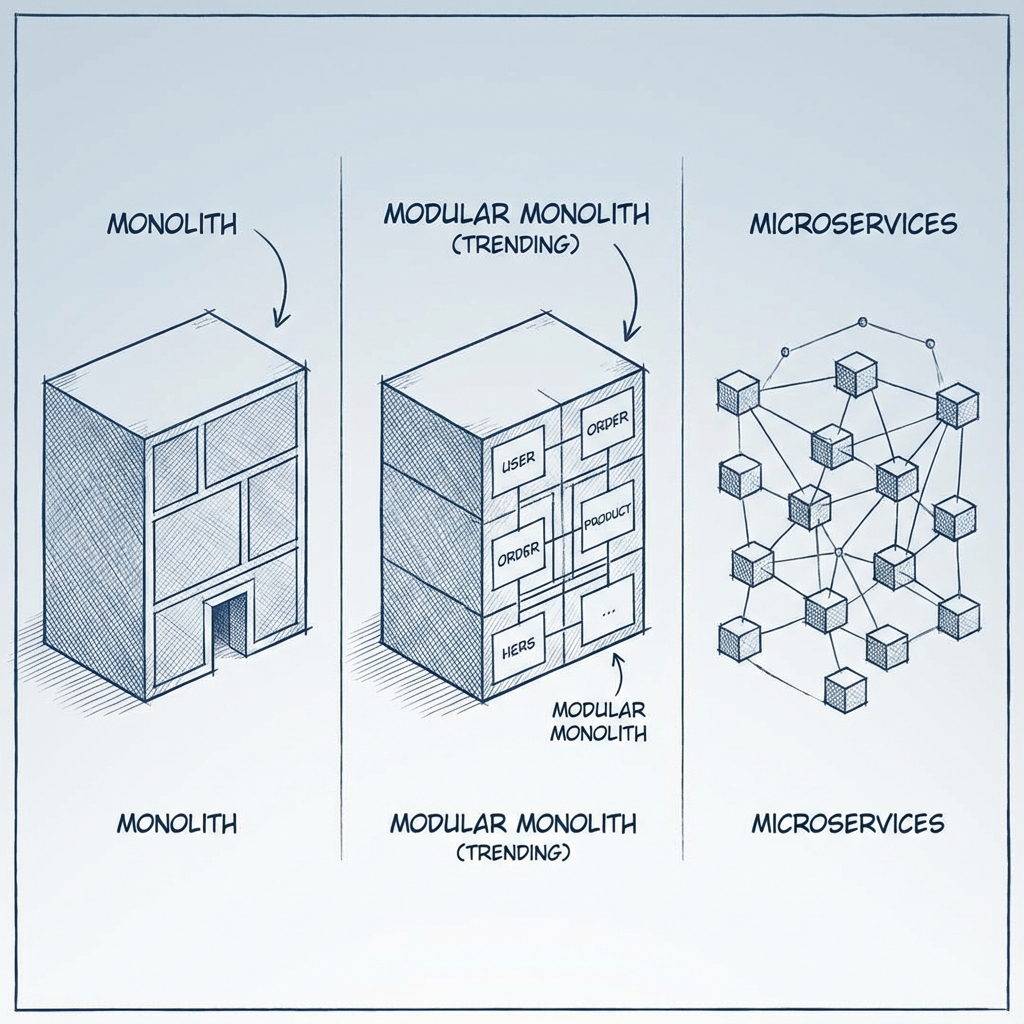
Enter the "Modular Monolith"(Modulith)
The false dichotomy is "Spaghetti Monolith" vs. "Clean Microservices." There is a middle ground.
A Modular Monolith is a single deployable unit(one binary / container), but the code is strictly organized into independent modules(e.g., Billing, Auth, Cart).Module A cannot import Module B's database models directly; it must use a public interface.
Benefits:
- Zero Latency: Function calls are instant. No gRPC/PROTOC overhead.
- Simplified Ops: One container to monitor. One database to back up.
- Atomic Transactions: You can use ACID database transactions across modules without complex "Saga Patterns."
When should you * actually * use Microservices ?
Microservices are not an architecture for code; they are an architecture for people .
You need them when:
- Independent Scaling: The video transcoding service needs 100 GPUs, but the login service needs 1 CPU.
- Team Size: You have 200 developers. You literally cannot merge code into the same repo without stepping on toes.
- Technology Heterogeneity: You really need Python for Data Science and Rust for the Engine.
Conclusion: Resume - Driven Development
A lot of microservices were built not because the application needed them, but because the architect wanted "Kubernetes" on their LinkedIn profile.In 2025, the mature choice is to start Monolithic and split only when it hurts.