Leading High-Performance Remote Teams: The Async First Management Style
Remote work requires more writing and less meeting.We need to document our decisions and create a culture of transparency.When you can't tap someone on the shoulder, your documentation becomes your office. Leading a remote team isn't about better Zoom etiquette; it's about re-architecting how information flows.
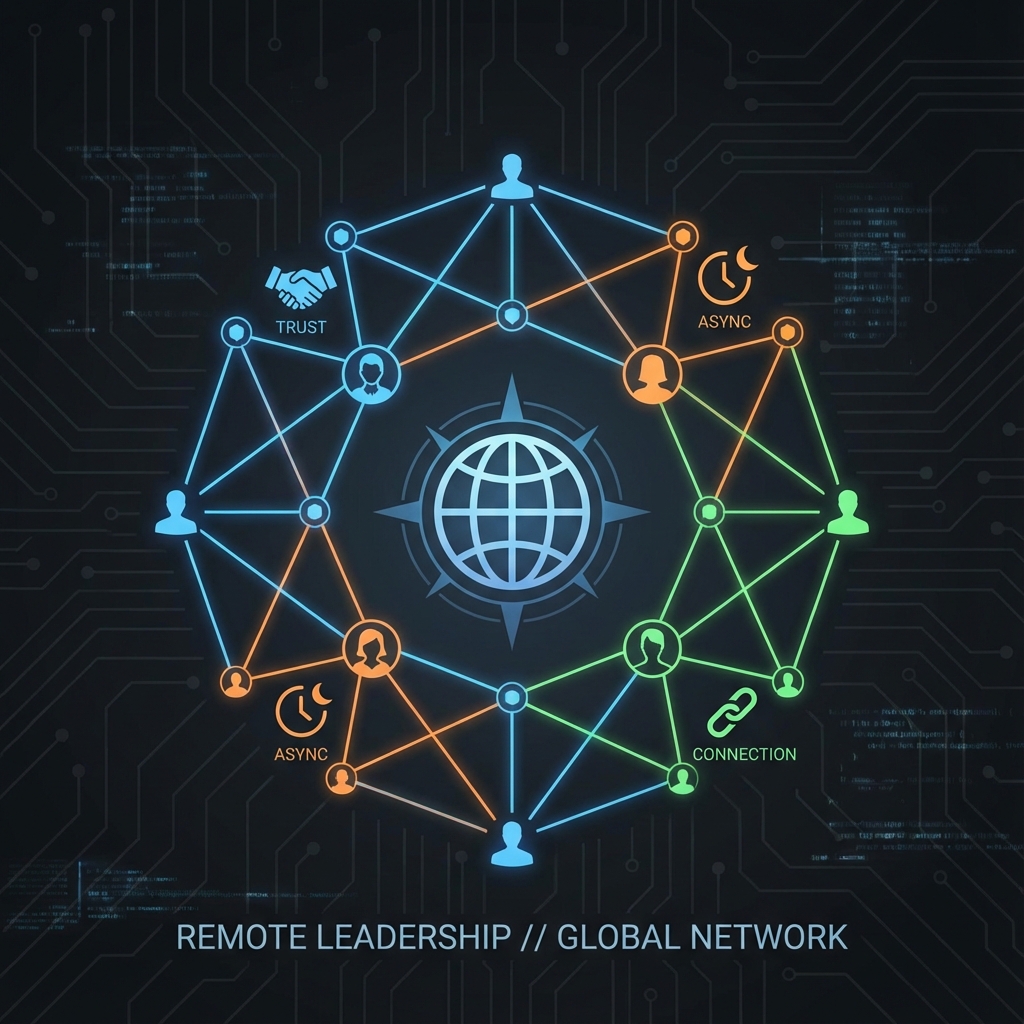
1. The "Remote-Friendly" vs "Remote-First" Trap
Remote - Friendly means you have an HQ, but some people are allowed to dial in. This creates second-class citizens. The people in the office make decisions over lunch; the remote people hear about them a week later. They are "out of sight, out of mind."
Remote - First means the workflow assumes everyone is remote, even if they are sitting next to each other.
The Golden Rule: If one person is on Zoom, everyone is on Zoom. If a decision isn't written down in a public channel (Slack/Confluence / Notion), it didn't happen.
You cannot scale a distributed team if the "source of truth" is the hallway conversation.
2. Async by Default, Sync by Exception
The Sync Trap: Most companies copy-paste office culture to remote. They have "Standups" at 9 AM, "Syncs" at 2 PM, and "Wrap-ups" at 5 PM.
This destroys Deep Work.An engineer needs 4 - hour blocks of uninterrupted time to load context into their mentally RAM.If you interrupt them every 2 hours, they achieve zero flow state.
The Solution: Move status updates to text (Slack/Geekbot). Move demos to video(Loom).
Reserve synchronous meetings for the "3 D's":
- Debate: We have two opposing views (e.g., Architecture decision) and need to fight it out dynamically.
- Decision: We have all the context, now we need to commit to a path forward.
- Development(Relationship): 1:1s, team bonding, feedback, coaching.
Everything else (status updates, information sharing, announcements, "checking in") should be an email, a Slack message, or a document.
3. The "Written" Culture
In a remote team, writing is not a "nice to have" skill; it is a core competency.If you cannot write clearly, you cannot lead remotely.
Amazon has 6 - page mechanics.GitLab has the Handbook.Stripe has "Home."
Why Writing Wins:
- Clarity of Thought: You can't hand-wave a bad idea in a document like you can in a presentation. Writing forces you to structure your logic.
- Inclusion: Introverts and non-native speakers can read, process, and comment on a doc much easier than speaking up in a loud meeting with dominant personalities.
- Time Travel: It creates an artifact. Future employees can read why a decision was made in 2023, without needing to ask you.It scales your knowledge.
Leadership Tip: Stop answering questions in DM. Answer them in public channels or docs, then link the doc. "Let me Google that for you" becomes "Let me Notion that for you."
4. Trust vs.Surveillance(The "Butt-in-Seat" Fallacy)
Bad Managers: Install "bossware" to track mouse movements or take screenshots every 10 minutes. This signals: "I do not trust you." It breeds resentment and gaming of the system.
Good Managers: Set clear outcomes (OKRs/KPIs) and get out of the way.
If you trust your team, they will over - deliver.If you treat them like children, they will behave like children.
Key Metric: Focus on "Output per Week" (Pull Requests, Docs Written, Features Shipped) rather than "Hours Online." If someone ships a feature in 2 hours and spends the rest of the day hiking, that's efficiency, not laziness. Reward it.
5. Intentional Socializing
Remote work can be lonely. You don't bump into people at the coffee machine. You must engineer serendipity.
Ideas that actually work:
- Donut pairs: Random 1:1 coffee chats on Slack (automated). 15 mins, no work talk allowed.
- Gaming Hours: Friday afternoon Among Us, Codenames, or Factorio. It builds camaraderie better than a "Zoom Happy Hour" where only one person can talk at a time.
- Offsites: Fly everyone to a location once a quarter. The ROI on this is infinite. Build trust in person (high bandwidth); spend it remotely (low bandwidth).
- "Always On" Audio Channel: A Discord voice channel or Tuple room where people can sit and work in silence, simulating a co-working space.
6. Hiring for Remote DNA
Not everyone is built for this. Some people need the energy of an office. When hiring, screen for:
- Self-management: Can they unblock themselves? Do they know how to find answers when you are asleep?
- Writing ability: Ask for a written explanation of a complex topic during the interview process. If their email communication is messy, their code documentation will be messy.
- Over-communication: Do they proactively update you before you ask? "I'm stepping away for 2 hours to pick up kids" is better than disappearing.
7. Mental Health & Burnout
The danger of remote work isn't that people slack off; it's that they never stop working.
When your office is your living room, there is no commute to decompress. Work bleeds into life.
Leader's Duty:
- Model behaviour: Don't send Slacks at 11 PM. If you do, schedule them for 9 AM the next day.
- Enforce time off: If someone hasn't taken leave in 3 months, tell them to take a Friday off.
- Watch for silence: In an office, you see if someone looks tired. Remote, they just go silent. Silence is a red flag for burnout.
8. The "Written" Culture Part 2: Decision Frameworks
Writing is hard. To scale it, you need frameworks.
- DACI (Driver, Approver, Contributor, Informed): Use this for every major project. It clarifies roles upfront. The Driver pushes the doc. The Approver (single person) makes the call.
- SPADE (Setting, People, Alternatives, Decide, Explain): Square's famous decision-making frame. It forces you to list alternatives and explain why you rejected them.
- RFC (Request for Comments): The standard engineering proposal format. "I want to change X. Here is why. Here are the risks."
9. Async Brainstorming
How do you innovate without a whiteboard?
The "Silent Meeting" (Amazon Style):
1. Write a Google Doc / Notion page proposing the idea.
2. Schedule a 30-minute meeting.
3. Spend the first 15 minutes reading silently and commenting on the doc.
4. Spend the last 15 minutes discussing the controversy.
This is superior to "Brainstorming" where the loudest extrovert wins.
10. Global Compensation: The Ethics of Pay
If you hire a dev in Nigeria who is as good as a dev in San Francisco, do you pay them SF rates?
Option A: Location-Based Pay (GitLab): You pay based on the local cost of labor. Fair to the local market, but feels unfair to the employee.
Option B: Value-Based Pay (Basecamp): You pay everyone SF/Chicago rates regardless of where they live. This attracts the absolute best talent globally, but is expensive.
Choose your philosophy and be transparent about it. Obscurity breeds distrust.
11. Culture Scaling: From 10 to 100
What works for 5 people (group chat) fails for 50 (noise).
The Dunbar Number: Humans can maintain ~150 relationships.
Documentation as Culture: Culture is not "swag." Culture is "how we do things." If "how we do things" depends on asking Jeff, you have a bottleneck. If it's written down, it scales.
Rituals:
- Monthly All-Hands (recorded).
- Weekly "Show and Tell" (demos only, no slides).
- Quarterly "Hack Weeks."
12. The Remote Hiring Pipeline
Resume screening is broken.
The "Work Sample" Test: Don't ask Leetcode. Ask them to do a 2-hour task that mirrors real work. Pay them for it.
The "Written" Interview: Do a text-based technical interview. No Zoom. Just a shared Google Doc. Watch how they think, edit, and communicate in real-time. This filters for the #1 remote skill: Writing.
13. Remote Retreats: A Planning Guide
You save money on rent. Spend it on retreats.
Frequency: Twice a year.
Agenda:
- Day 1: Arrivals + Dinner. No work.
- Day 2: "State of the Union" + Hackathon.
- Day 3: Activity (Hiking, Cooking Class).
- Day 4: Department Strategy (Eng breaks out, Product breaks out).
- Day 5: Departures.
Goal: Build "Social Capital" that you deplete over the next 6 months of Zoom calls.
14. The Global Compensation Debate
Should you pay San Francisco rates in Bangalore?
The Argument for Local Pay: Cost of living adjustment. It's "fair" relative to their local market.
The Argument for Equal Pay: Equal work, equal pay. If they deliver the same value, why discount it?
The Compromise: Base pay on a "Global Tier 1" rate (e.g., London/Berlin) rather than SF/NYC. This attracts top talent worldwide without bankrupting the company.
Reality Check: If you pay local rates, you will lose your best engineers to companies that pay global rates. The market for talent is global now. Accept it.
This debate will not be settled by ethics, but by economics. If a developer in Lagos produces the same code as a developer in London, arbitrage will eventually close the gap. Companies that exploit this gap short-term will lose long-term.
Conclusion
Remote leadership is just leadership, distilled. It strips away the charisma of the "loudest voice in the room" and rewards the clearest thinker on the page. It forces you to be a better manager because you can't rely on presence to solve problems. Embrace the async, trust your team, and write everything down.