Navigating AI Anxiety: A Rational Framework for Career Decisions
The discourse around AI and careers has two poles, both wrong. On one end: "AI will replace everyone, learn to code or die." On the other: "AI is just a tool, relax, nothing will change." The truth is more nuanced, more interesting, and more actionable than either extreme. What you need isn't reassurance or alarm. You need a framework — a systematic way to assess your specific situation and make rational career decisions based on evidence, not vibes.

The Anxiety is Rational (But Usually Misdirected)
Let's start by validating the anxiety. It's not irrational to worry about AI's impact on your career. McKinsey's research estimates that generative AI could automate 60-70% of the tasks that currently occupy workers' time. That's a staggering number. If you're not at least thinking about this, you're not paying attention.
But here's the critical nuance that most people miss: task automation is not job elimination. McKinsey's own data shows that while 60-70% of tasks may be automatable, the percentage of jobs that are fully automatable is closer to 5-10%. The difference? Most jobs are bundles of tasks, and AI automates some tasks while leaving others untouched or even expanding them.
A financial analyst's job includes data gathering (highly automatable), pattern recognition (partially automatable), client communication (barely automatable), and strategic judgment (not automatable). AI doesn't eliminate the analyst. It transforms what the analyst does — and, likely, reduces the number of analysts needed while increasing the output per analyst.
This distinction — between task exposure and job exposure — is the foundation of rational career decision-making in the AI era.
The Exposure Assessment Framework
Here's a four-step framework for assessing your personal AI exposure. I recommend actually doing this exercise with pen and paper — the act of writing forces clarity.
Step 1: Task Decomposition
List every significant task you perform in a typical month. Not your job title, not your responsibilities — your actual tasks. Be granular. "Manage team" becomes "conduct 1:1s," "review PRs," "write performance reviews," "resolve conflicts," "plan sprints," "represent team in leadership meetings."
For each task, estimate the percentage of your total work time it consumes. The numbers should add up to roughly 100%.
Step 2: Automation Potential Scoring
For each task, score its automation potential on a 1-5 scale:
- 1 — Not automatable: Requires physical presence, deep empathy, creative originality, or navigating novel/ambiguous situations. Examples: crisis management, high-stakes negotiations, creative direction.
- 2 — Slightly automatable: AI can assist but a human must lead. Examples: strategic planning, complex writing, mentoring.
- 3 — Partially automatable: AI can do 50-70% of the work, human refines. Examples: data analysis, report writing, code review.
- 4 — Mostly automatable: AI handles 80-90%, human does final review. Examples: routine communications, standard documentation, basic research.
- 5 — Fully automatable: AI can do this as well or better than you. Examples: data entry, scheduling, basic translations, simple code generation.
Step 3: Weighted Exposure Score
Multiply each task's time percentage by its automation score. Sum the results. This gives you your Weighted Exposure Score (WES) on a 1-5 scale.
- WES 1.0-2.0: Low exposure. Your role is relatively insulated. Focus on deepening your existing advantages.
- WES 2.0-3.0: Moderate exposure. Your role will transform significantly. Focus on shifting your time toward lower-automation tasks.
- WES 3.0-4.0: High exposure. Your role will likely be consolidated or restructured. Proactive career moves are advisable.
- WES 4.0-5.0: Critical exposure. Start transitioning now. The timeline is 2-3 years, not 5-10.
Step 4: Trajectory Analysis
Your WES isn't static. AI capabilities are improving. Re-score each task assuming 2-year AI progress. Are tasks you scored as "2" today likely to become "3" or "4" by 2028? This trajectory matters more than the current score.
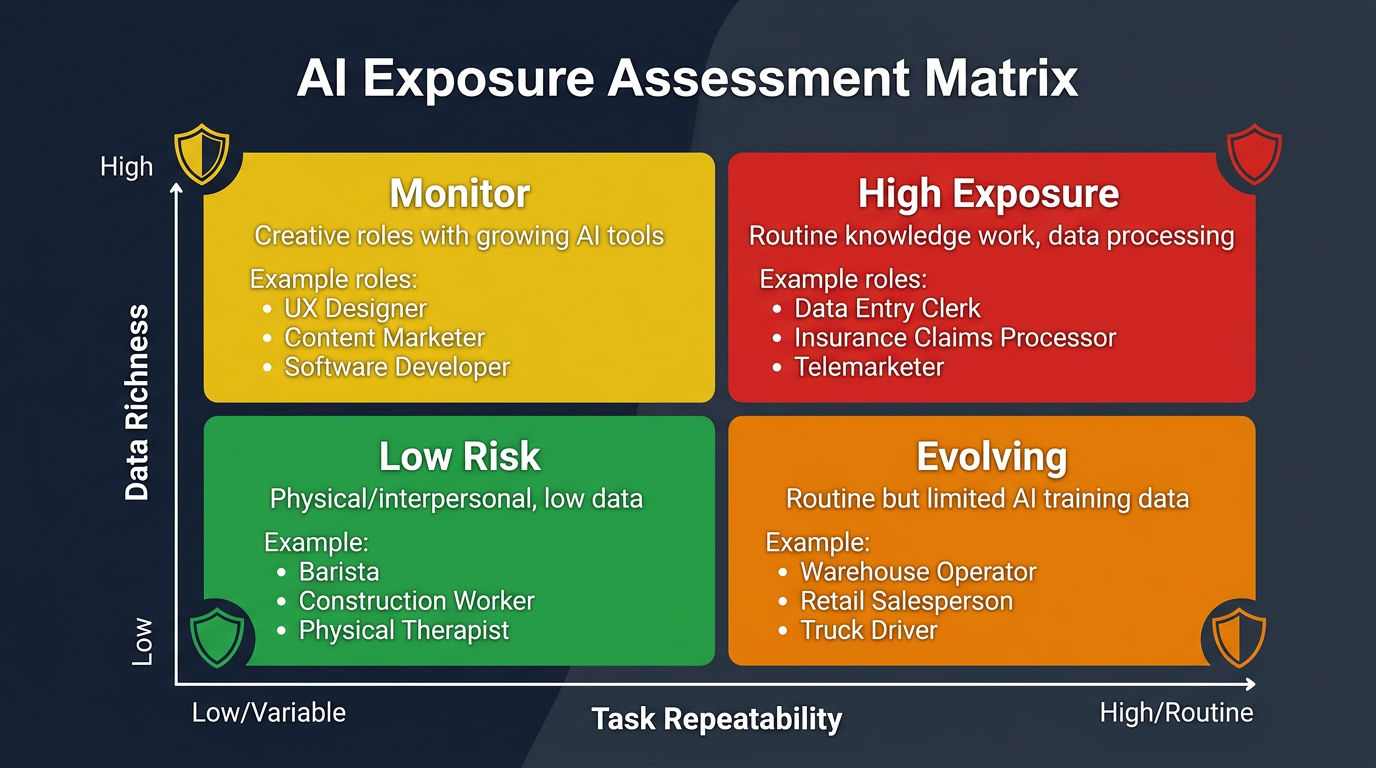
The Durable Advantage Inventory
Once you understand your exposure, the next step is identifying your durable advantages — the capabilities you have that are hardest to replicate with AI and most valuable in a transformed market.
Category 1: Contextual Knowledge
Deep understanding of a specific industry, company, market, or system that isn't captured in public data. The insurance underwriter who knows which risk factors matter in a specific region. The product manager who understands their company's technical debt well enough to know which features are easy and which are nightmares. AI can access general knowledge, but institutional and tacit knowledge remains human.
Category 2: Relationship Capital
Trust-based relationships that influence decisions. The sales executive whose clients buy because of the relationship, not the product. The engineering leader whose team follows them between companies. AI can't build genuine trust at this level.
Category 3: Judgment Under Uncertainty
The ability to make good decisions with incomplete information in novel situations. This is different from pattern matching (which AI does well) — it's about navigating situations where the patterns don't apply because the situation is genuinely new.
Category 4: Creative Integration
Combining ideas from disparate domains to create something new. AI generates within distributions it has seen. Genuine creative breakthroughs often come from connecting domains that haven't been connected before — and the connecting often happens through embodied experience, not data.
| Task Type | AI Capability | Exposure Level | Timeline |
|---|---|---|---|
| Data entry & processing | Excellent | Very High | Now |
| Report writing | Strong | High | 2025-2026 |
| Code generation | Strong | Medium-High | 2025-2027 |
| Strategic planning | Emerging | Medium | 2027-2030 |
| Client relationships | Weak | Low | 2030+ |
| Creative direction | Emerging | Low | 2030+ |
The Decision Matrix
Cross-reference your exposure score with your durable advantage inventory to determine your optimal strategy:
Low Exposure + Strong Advantages: Fortify
You're in a strong position. Deepen your advantages. Use AI to amplify your output. Invest in the relationships and contextual knowledge that make you irreplaceable in your specific context.
Low Exposure + Weak Advantages: Build
You have time but not a moat. Use the window to develop durable advantages — deep domain expertise, strong relationships, cross-domain skills. Don't be lulled by the current safety of your position.
High Exposure + Strong Advantages: Pivot
You have transferable strengths but your current role is vulnerable. Start actively repositioning toward roles where your durable advantages are more central and the automatable task load is lower. This is often a lateral move, not a step back.
High Exposure + Weak Advantages: Transform
This is the urgent quadrant. You need to make significant career moves — new skills, new domain, possibly new field. The good news: the same AI tools that threaten your current role can accelerate your transition. Use them aggressively to learn and build in new areas.
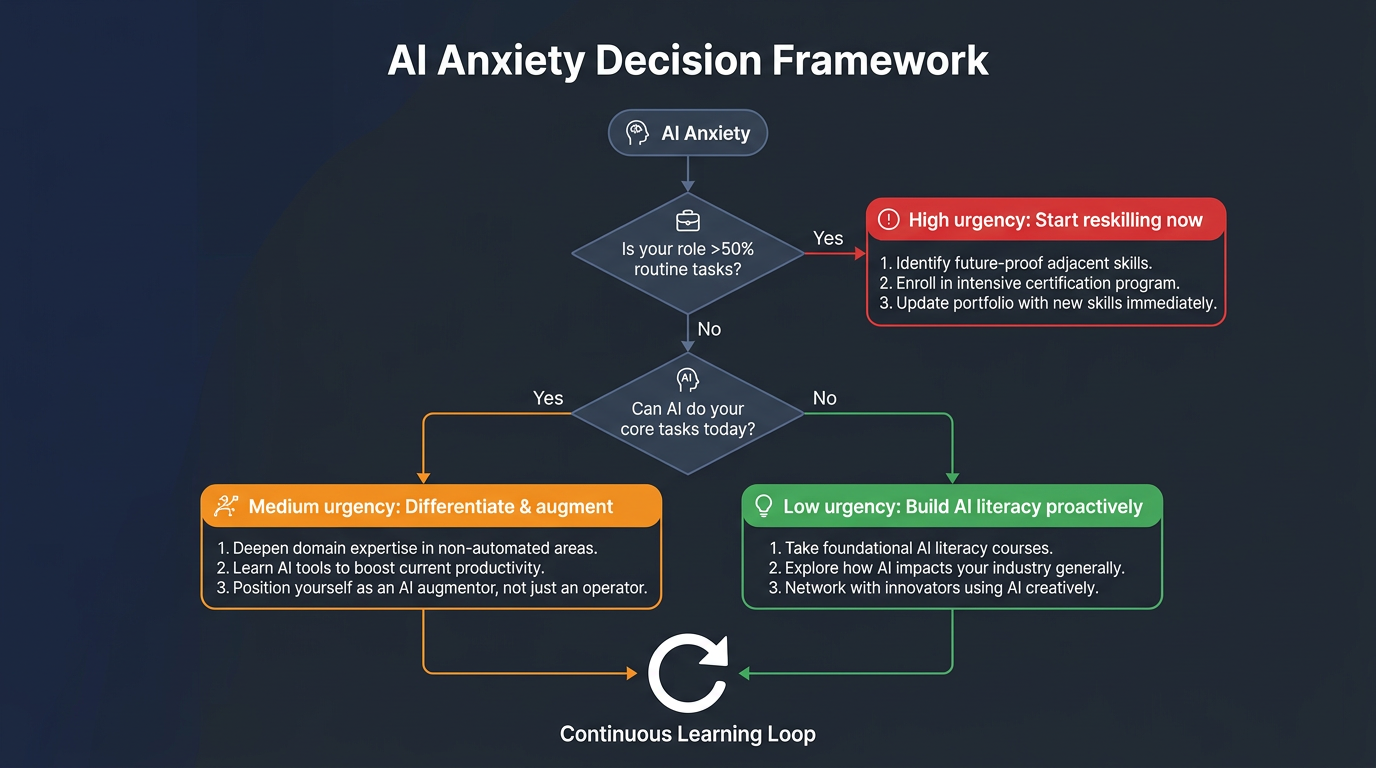
Common Mistakes in Career Reasoning
I see these errors repeatedly in conversations about AI and careers:
Mistake 1: Confusing Current Capability with Trajectory
"AI can't do what I do right now, so I'm safe." This is the equivalent of a taxi driver in 2015 saying "self-driving cars aren't good enough." The question isn't what AI can do today. It's what AI will be able to do by the time you've invested another 5 years in your current path.
Mistake 2: The Lump of Labor Fallacy
Assuming there's a fixed amount of work to be done, so AI doing more means humans doing less. History consistently shows that automation creates more total work, even as it eliminates specific jobs. The question isn't whether work will exist — it's whether your skills match the work that emerges.
Mistake 3: Assuming Your Industry Is Special
"AI works for tech, but my industry is different." Every industry thinks it's special. Healthcare said this about electronic records. Law said this about document review. Accounting said this about tax preparation. AI's reach is domain-agnostic — it follows the task characteristics, not the industry label.
Mistake 4: Over-Indexing on Technical Skills
"I should learn to code / learn ML." Maybe. But technical skills are often the most automatable. The durable skills — judgment, relationships, creativity, domain expertise — are less tangible but more defensible. Don't assume that running toward technology is the right response to technological disruption.
The Proactive Career Playbook
Based on the framework above, here's what proactive career management looks like in 2026:
- Quarterly reassessment. Redo your exposure assessment every quarter. AI capabilities are changing fast enough that annual planning is too slow.
- Skill portfolio diversification. Don't put all your career capital in one skill. Maintain a portfolio of capabilities spanning the automatable-to-durable spectrum.
- Strategic visibility. Make your durable advantages visible. If your value is judgment and relationships, ensure that the people making headcount decisions understand this. The people who get laid off in AI-driven restructuring are often those whose human value was invisible.
- Network in adjacent domains. Your next role may not exist in your current industry. Build relationships in areas where your transferable skills are valued.
- Embrace AI publicly. Ironically, demonstrating AI fluency is one of the best ways to signal that you understand the transformation and can navigate it. Be the person on your team who knows how to use AI effectively. That person is the last to be automated away.
Low Exposure Strategy
Build AI literacy proactively. Learn to use AI tools to amplify your already-durable skills. Stay curious.
Medium Exposure Strategy
Differentiate from AI outputs. Deepen domain expertise. Position yourself as the human-in-the-loop expert.
High Exposure Strategy
Start reskilling now. Identify adjacent roles with lower exposure. Build a portfolio of new skills over 6-12 months.
Critical Exposure Strategy
Urgent career pivot needed. Enroll in intensive programs. Consider roles that manage/govern AI rather than compete with it.
The Emotional Component
I want to end on something that frameworks can't capture. Career anxiety isn't purely rational. It's tied to identity, self-worth, and the human need for purpose. If your job disappears, it's not just income that's threatened — it's how you answer the question "what do you do?"
The healthiest response I've seen is to decouple identity from role. You're not "a copywriter" — you're someone who understands how language persuades. You're not "a data analyst" — you're someone who finds truth in noise. The role is the current expression of something deeper. If AI transforms the expression, the underlying capability remains yours.
That's not just a coping mechanism. It's a career strategy.
References & Further Reading
- McKinsey — The Economic Potential of Generative AI
- Goldman Sachs — Generative AI Could Raise Global GDP by 7%
- World Economic Forum — Future of Jobs Report 2025
- OECD — AI and the Labour Market
- Wait But Why — The AI Revolution (Parts 1 & 2)
- Harvard Business Review — How to Future-Proof Your Career in the Age of AI