Micro-Frontends: The Good, The Bad, and The Ugly
Micro - services won the backend war(mostly).Now, the frontend is facing the same existential crisis.Should we build one giant React app ? or split it into 20 tiny React apps ? Micro - frontends solve organizational problems, not technical ones.Adopt them only when your organization structure demands it.If you have 5 teams tripping over each other in the same React codebase, micro - frontends might be the answer.But be warned: the tax you pay is high.
1. The Problem: The Monolithic Frontend
Imagine a "Super App" like Amazon.You have:
- Search Team: Wants to optimize the search bar and results listing.
- Checkout Team: Needs 100% stability and zero bugs.
- Recommendations Team: Wants to A/B test wildly.
- Prime Video Team: Wants to use a custom video player.
In a monolith, they all push to the same main branch.
The Bottleneck:
- "I can't deploy because the Checkout team broke the build."
- "My fast A/B test is stuck behind a 2-hour E2E test suite required for the Payments module."
- "We want to upgrade to React 19, but the Legacy Dashboard team refuses to migrate."
2. The "Vertical Slice" Architecture
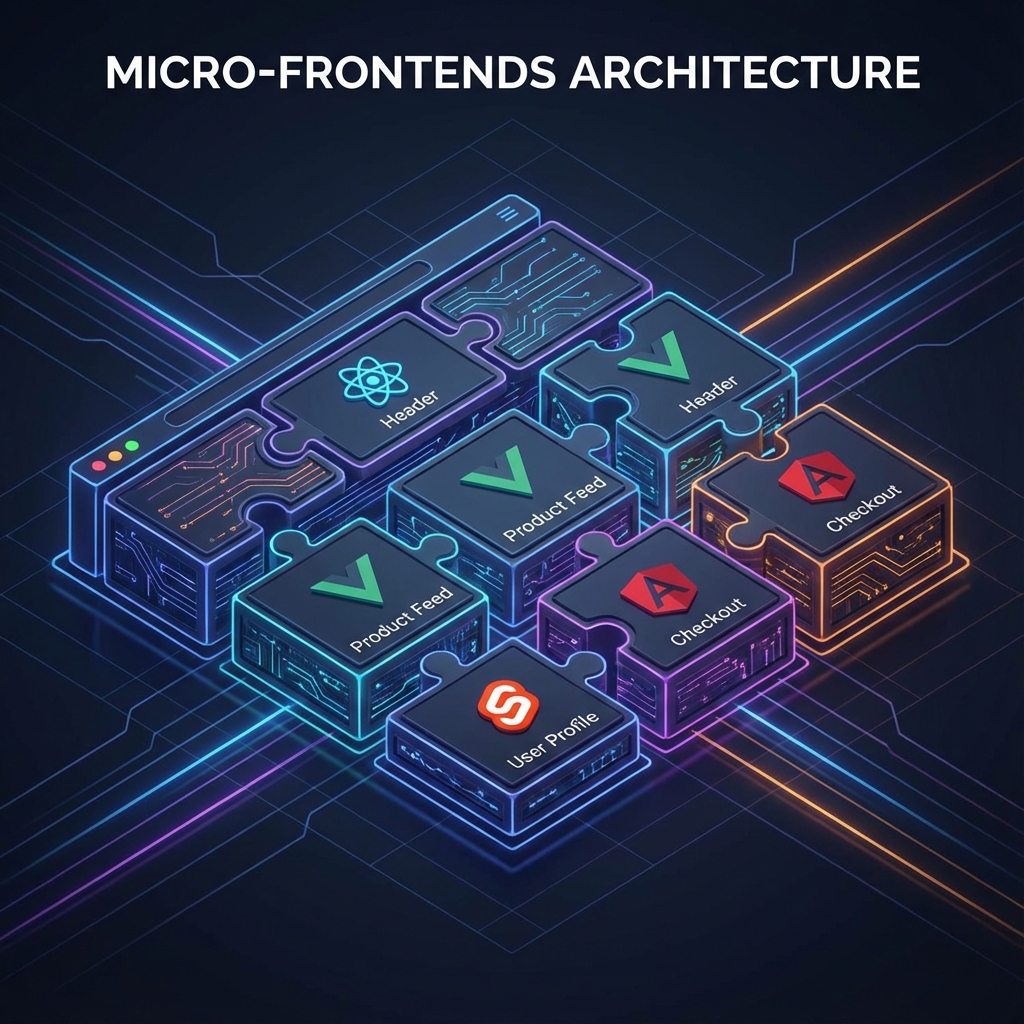
Micro - frontends propose a radical shift: Instead of slicing horizontally(Frontend Repo, Backend Repo), slice vertically(Checkout Repo, Search Repo, Profile Repo).
Each micro - frontend should be end - to - end: it owns its UI, its API endpoints, its database tables, and its deployment pipeline.
Benefit: Autonomous Deployments.
The "Checkout" team can ship a bug fix on Friday at 5 PM without talking to the "Search" team.They have their own CI / CD.They are effectively their own startup within the company.
3. Integration Patterns
How do we stitch these fragments back together into a cohesive UI ?
A.Build - Time Integration(npm packages):
Publish each app as a library.Import them into a "Container App."
Pros: Easy to understand.
Cons: Tight coupling. To release a change in "Checkout", you must bump the version in "Container" and redeploy "Container". This defeats the purpose of independent deployment.
B.Server - Side Integration(SSI / Edge Includes):
Nginx or Edge Workers assemble the HTML before it hits the browser.
Pros: Great for SEO (First Contentful Paint).
Cons: Hard to handle client-side interactivity and shared state.
C.Run - Time Integration(The Holy Grail):
The Container App loads bundles(JS) dynamically at runtime.
Technology: Webpack Module Federation or Vite Federation.
Pros: True independence. Team A deploys a new JS bundle to S3. Team B's user refreshes the page and gets the new code instantly.
4. The Integration Tax(The Cost)
The cost of micro - frontends is paid at the edges.Complexity assumes conservation; you just moved it from the code to the infrastructure.
1. Performance(The Duplicate Dependencies Problem):
If App A uses React 17 and App B uses React 18, the user downloads two React runtimes. This crushes performance on mobile. You must enforce "Shared Dependencies," which re-introduces coupling.
2. Styling Bleed:
App A defines h1 { color: red } . App B loads on the same page. Suddenly, App B's headers are red.
Solution: Shadow DOM (heavy), CSS Modules (requires build tooling), or CSS-in-JS (runtime cost).
3. State Management:
How does the "Header"(App A) know that the user added an item to the "Cart"(App B) ?
Solution : You need a global Event Bus or a shared Store (Zustand/RxJS) exposed via the window object.This is fragile.If you break the contract, the app crashes.
4. Design System Divergence:
Without a strictly enforced Design System library, App A will use "Blue-500" and App B will use "Blue-600".The UI will look like a Frankenstein monster.
5. Testing Strategies
Unit Tests: Easy. Test inside the repo.
Integration Tests: Hard. You need to mock the other micro-frontends.
E2E Tests: A nightmare. Who owns the E2E test for the "User Journey" that spans 4 different apps? If it fails, who wakes up?
Best Practice: Consumer-Driven Contract Testing (Pact). Ensure that if App A expects App B to export a function addToCart(id, qty), App B actually does that.
6. Conway's Law is Real
"Any organization that designs a system will produce a design whose structure is a copy of the organization's communication structure."
Micro - frontends match a decentralized organization.Monoliths match a centralized one.
Startups(<20 engineers): You communicate in one Slack channel. Build a Modular Monolith (e.g., Nx Monorepo). It gives you code separation without the deployment complexity.
Scale - ups(100 + engineers): You have 10 teams. Your communication is broken. Break the monolith.
7. The Alternative: The Modular Monolith
Before you jump to Micro - Frontends, consider the Modular Monolith.
Keep code in one repo.Use tools like Nx or Turborepo to enforce boundaries(e.g., "Checkout" library cannot import "Search" library).
Deploy everything at once.
This solves the "Spaghetti Code" problem without introducing the "Distributed Systems" problem.For 99 % of companies, this is the right choice.
Conclusion
Micro - frontends are not a default. They are a "Break Glass in Case of Emergency" architecture.
Do not use them because they are trendy.Use them because your organizational pain is so high that you are willing to accept the technical pain of distributed systems to solve it.Complexity is the enemy.Choose the simplest architecture that your team structure allows.