Managing Technical Debt in the Age of AI
We used to say "I'll refactor this later," knowing it was a lie.But with LLMs, "later" might actually be today.AI is changing the economics of paying down technical debt.
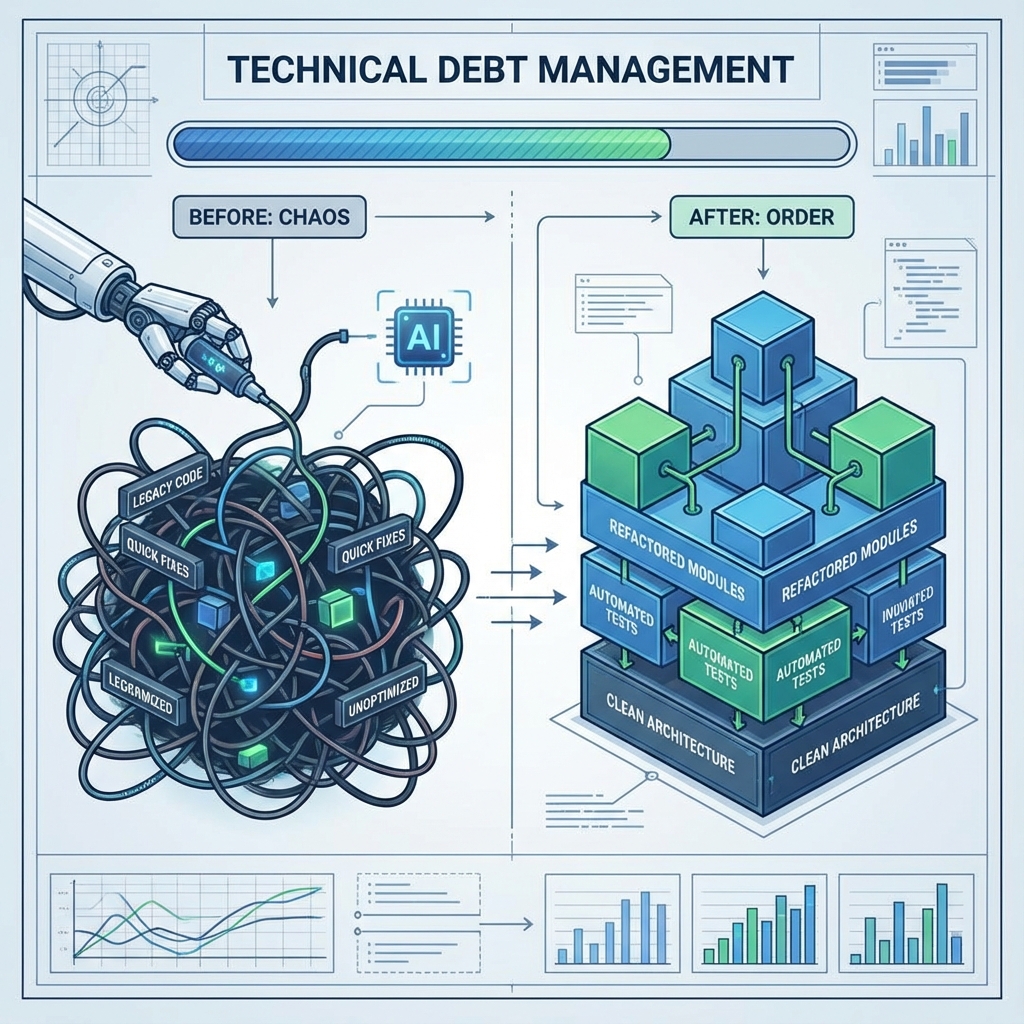
The Economics of Debt
Technical debt isn't inherently bad. It's leverage.It allows you to ship early to find product - market fit.The problem is not taking on debt; it's servicing the interest. "Interest" is the time your developers spend waiting for tests to run or debugging brittle code.
Strategy 1: The "Archaeologist"(Understanding Legacy Code)
The scariest part of refactoring is the "Chesterton's Fence" principle: You don't know why this weird if (true) statement exists, so you're afraid to delete it.
The AI Fix: Paste the legacy function into an LLM and ask: "Explain this code line by line. Why might the original author have written it in this way?" Tools like Copilot Chat can "Explain this file" instantly, acting as a translator for ancient Hieroglyphics (or PHP 5).
Strategy 2: The "Safety Net"(Test Generation)
You can't refactor without tests. But writing tests for 10-year-old code is soul-crushing.
The AI Fix: "Write a Jest unit test for this function that covers 100% of branches." It's not always perfect, but generating the boilerplate for 50 tests takes seconds. This gives you the confidence to start ripping out the rot.
Strategy 3: The "Strangler Fig" Pattern
Instead of a Big Bang rewrite(which always fails), use the Strangler Fig pattern: slowly replace pieces of the monolith with new microservices.
The AI Fix: AI is excellent at "Transbilation." You can ask it to "Convert this Python class into a TypeScript interface." It reduces the friction of moving logic to a new stack.
The New Risk: "AI Debt"
While AI solves old debt, it creates new debt.
- Boilerplate Explosion: Because it's easy to generate code, developers are shipping more lines of code than ever. More lines = more surface area for bugs.
- The "Black Box" Problem: If you accept an AI suggestion you don't understand, you have just added debt that you cannot service.
Measuring the Debt Ceiling
You need to track debt like a CFO tracks liabilities.
- TODO Count: Is it going up or down?
- Dependabot Alerts: How many libraries are out of date?
- Code Coverage: Is the safety net growing?
Conclusion
AI gives us a "Bailout" for technical debt.It allows us to do the janitorial work—docs, tests, types—at 10x speed.But it requires discipline.Use the extra time to actually clean the house, not just to build more extensions.