The JAMstack Revolution
Static doesn't mean boring. JAMstack proves we can have dynamic, rich experiences with the security and speed of static files. By decoupling the frontend from the backend, we simplify our deployment pipeline and reduce our attack surface.
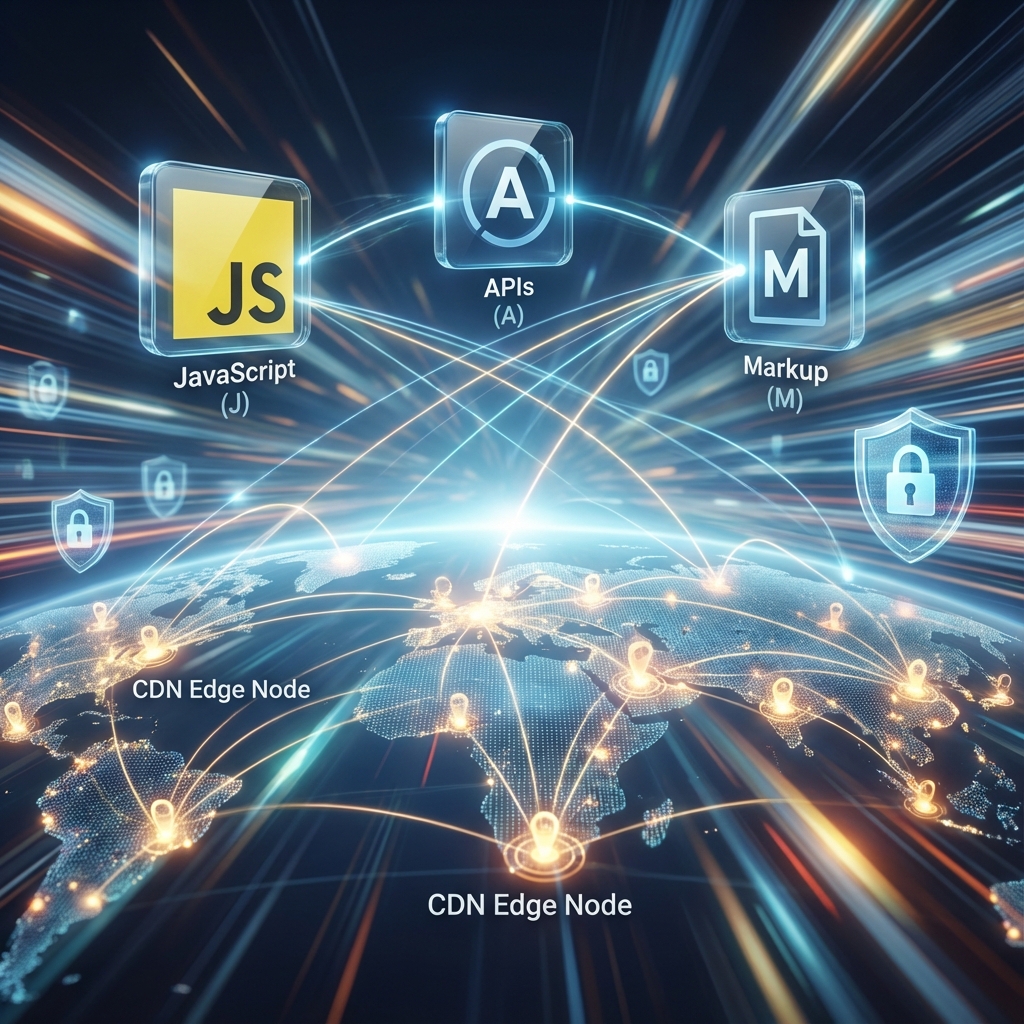
What is JAMstack ?
JAMstack stands for J avaScript, A PIs, and M arkup. It's a modern web development architecture based on client-side JavaScript, reusable APIs, and prebuilt Markup.
The Golden Rule: When the user requests a page, the server should do as little work as possible. ideally, no work.It should just return a file.
The Evolution from LAMP to JAM
In the WordPress / LAMP era, every page view triggered a database query.
User requests / about -> Apache runs PHP -> PHP queries MySQL -> PHP builds HTML -> Apache sends HTML.
This is fragile(DB crash = site down) and slow(TTFB is high).
In JAMstack:
Developer pushes code -> Build Server runs(SSG) -> HTML deployed to CDN.
User requests / about -> CDN sends HTML.
This is resilient(CDN doesn't crash) and instant.
Edge Computing: The New Backend
Originally, JAMstack meant "Static Site Generation"(SSG).But static is limiting.You can't do personalization or A/B testing.
Enter the Edge . Networks like Cloudflare and Vercel allow us to run compute at the CDN node.This is "Serverless," but widely distributed.
Middleware allows us to intercept the request at the edge, check a cookie, and rewrite the response—all in <50ms. The line between "Static" and "Dynamic" is blurring.
The API Economy
The "A" in JAMstack is critical.We stopped building monolithic backends.Instead, we compose applications from specialized SaaS APIs:
Identity
Auth0, Clerk, Supabase Auth
Content
Sanity, Contentful, Strapi
Commerce
Shopify, Stripe, Medusa
Search
Algolia, Meilisearch
This is the "Composable Web." You don't build a CMS; you subscribe to one. This reduces maintenance burden but increases integration complexity.
Performance Metrics
JAMstack sites dominate Core Web Vitals:
- LCP(Largest Contentful Paint): Near instant because HTML is pre-generated.
- TTFB(Time to First Byte): Low because CDNs are physically close to users.
- CLS(Cumulative Layout Shift): stable because images/data are often known at build time.
Security: Reduced Attack Surface
If you don't have a server, you can't have a server vulnerability.No SQL injection(no database connected directly).No unpatched WordPress plugins.The only attack vector is the APIs you call, and those are managed by billion - dollar companies.
Conclusion
JAMstack is not just for blogs anymore.With Next.js, Remix, and Edge Functions, it is the default architecture for modern web applications.It shifts complexity from "Run Time"(fragile) to "Build Time"(robust).