Impact Mapping: Escaping the Feature Factory
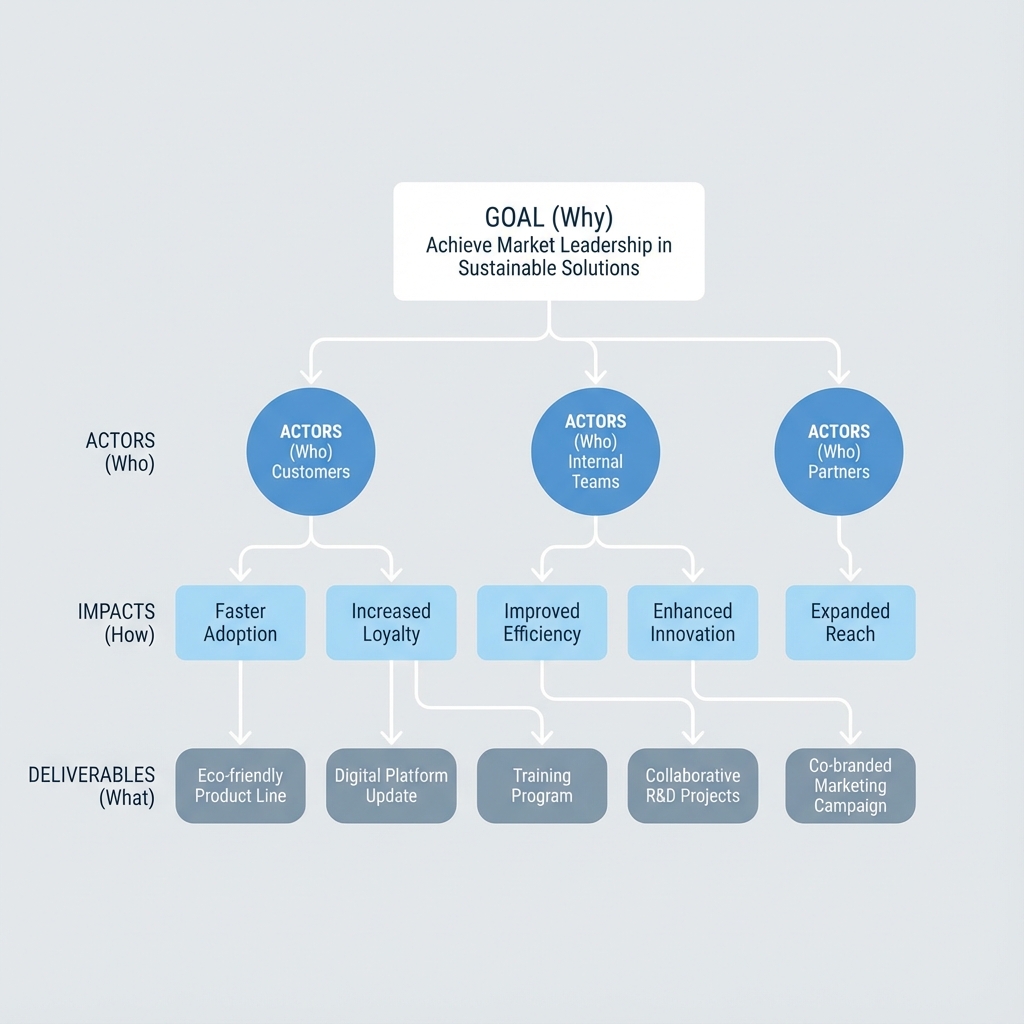
Don't fall in love with features. Fall in love with customer problems and business impacts. Most product teams are "Feature Factories"—they optimize for output (shipping code) rather than outcome (changing behavior). Impact Mapping is a strategic planning technique that visualizes the direct line from "What we do" to "Why we do it."
1. The Roadmap Trap(The Feature Factory)
The Traditional Roadmap: A Gantt chart listing features with arbitrary dates.
Q1: Dark Mode.Q2: CSV Export.Q3: AI Chatbot.
The Problem: Shipping "Dark Mode" is not a business goal. It's an output. Did it increase engagement? Did it reduce churn? Did it create value? We don't know. We get a dopamine hit from moving the Jira ticket to "Done," but the business metrics (Revenue, Retention) stay flat.
The Solution: Start with the Goal, not the Feature. Impact Mapping forces you to work backwards.
2. The 4 Layers of Impact Mapping
An impact map asks four questions in a strict order.You cannot move to the next layer until you validate the previous one.
Layer 1: The WHY(Business Goal)
This must be a S.M.A.R.T.goal(Specific, Measurable, Achievable, Relevant, Time - bound).
Bad: "Improve the mobile app."
Good: "Increase Mobile Adoption from 20% to 40% by Q4."
If you don't know why you are doing something, stop immediately.
Layer 2: The WHO(Actors)
Who can help us achieve this goal ? Who helps us, who obstructs us ?
Primary Actors: Users (e.g., "New Signups").
Secondary Actors: Internal teams (e.g., "Customer Support Agents").
Off - stage Actors: Regulators, Competitors (e.g., "Compliance Officer").
Stop saying "The User." Be specific. "The Admin User on a legacy plan" operates differently than "The Freemium User on mobile."
Layer 3: The HOW(Impact / Behavior Change)
This is the most critical layer.How should the Actor's behavior change to help us achieve the Goal?
Example:
- Goal: Increase Revenue.
- Actor: Free User.
- Impact: They upgrade to the Pro plan. OR They invite 3 colleagues.
Focus on behavior , not feelings. We can measure behavior.
Layer 4: The WHAT(Deliverable / Feature)
Only now do we talk about features.What can we build to encourage that behavior?
Impact: They invite 3 colleagues.
Deliverable:
- "One-click invite link."
- "Team Dashboard."
- "Referral Bonus discount."
This creates a menu of options.The "Team Dashboard" is expensive to build.The "Invite Link" is cheap.Since both drive the same Impact, do the cheap one first.
3. Case Study: Growing a B2B SaaS
Scenario: You run a Project Management tool (like Asana). You want less Churn.
Level 1(Why): Reduce Churn from 5% to 3%.
Level 2(Who): Team Admins (they hold the credit card).
Level 3(How - Impacts):
1. They confirm value faster during onboarding.
2. They successfully invite their whole team(network effect).
3. They integrate the tool with Slack(habit formation).
Level 4(What - Deliverables):
For "Integrate with Slack":
- Build a Slack Bot.
- Add a "Connect to Slack" button on the dashboard.
- Send an email tutorial about Slack integration.
The Win: We realized that "Building a Slack Bot" takes 3 months. But "Sending an email tutorial" takes 2 hours. If the email gets 50% of people to integrate, we achieved the goal without writing code.
4. Integrating with OKRs
Impact Mapping and OKRs(Objectives and Key Results) are best friends.
Objective: The "Why" (Qualitative).
Key Results: The "Why" metrics (Quantitative).
Initiatives: All the stuff in the "How" and "What" layers.
This aligns the engineering team with the C - suite.The C - suite cares about the Goal.The engineers care about the Deliverable.The Impact Map is the translation layer.
5. Facilitating an Impact Mapping Workshop
Do not do this alone in a dark room.Get a whiteboard(Miro / FigJam).Invite Engineering, Design, Sales, and Marketing.
Step 1: Write the GOAL in the center. Agree on it.
Step 2: Brainstorm Actors. Group them. Pick the most important one.
Step 3: Brainstorm Impacts. "What would they do differently?"
Step 4: Brainstorm Deliverables. "What can we build?"
Step 5: Vote. Pick the path of least resistance (High Impact, Low Effort).
This creates shared ownership.Engineers understand why they are building the "Invite Button"—not just because JIRA said so, but because it drives the "Invite Colleagues" behavior which drives "Revenue."
6. Common Pitfalls
- The "Kitchen Sink" Goal: "Increase revenue AND happiness AND performance." Pick one. Focus requires sacrifice.
- Skipping the "How": Jumping straight from Actor to Feature. "As a User, I want a Dark Mode." Why? What behavior does that drive? If you can't answer, don't build it.
- Treating it as a roadmap: An impact map is a tree of possibilities.You are not supposed to build everything on the map.You build the minimum subset required to hit the Goal.
Conclusion
Impact Mapping shifts the conversation from "When will feature X be done?" to "What is the fastest way to achieve Goal Y?"
It empowers teams to solve problems creatively instead of just taking orders.It is the antidote to the Feature Factory.Next time you are asked to put a feature on the roadmap, ask to see the Impact Map first.