How to Build an 'AI-First' Product Roadmap
Most roadmaps are linear.AI roadmaps are circular.You don't just "ship" a model; you deploy, observe, fine-tune, and redeploy. The traditional Q1-Q4 Gantt chart is dead.
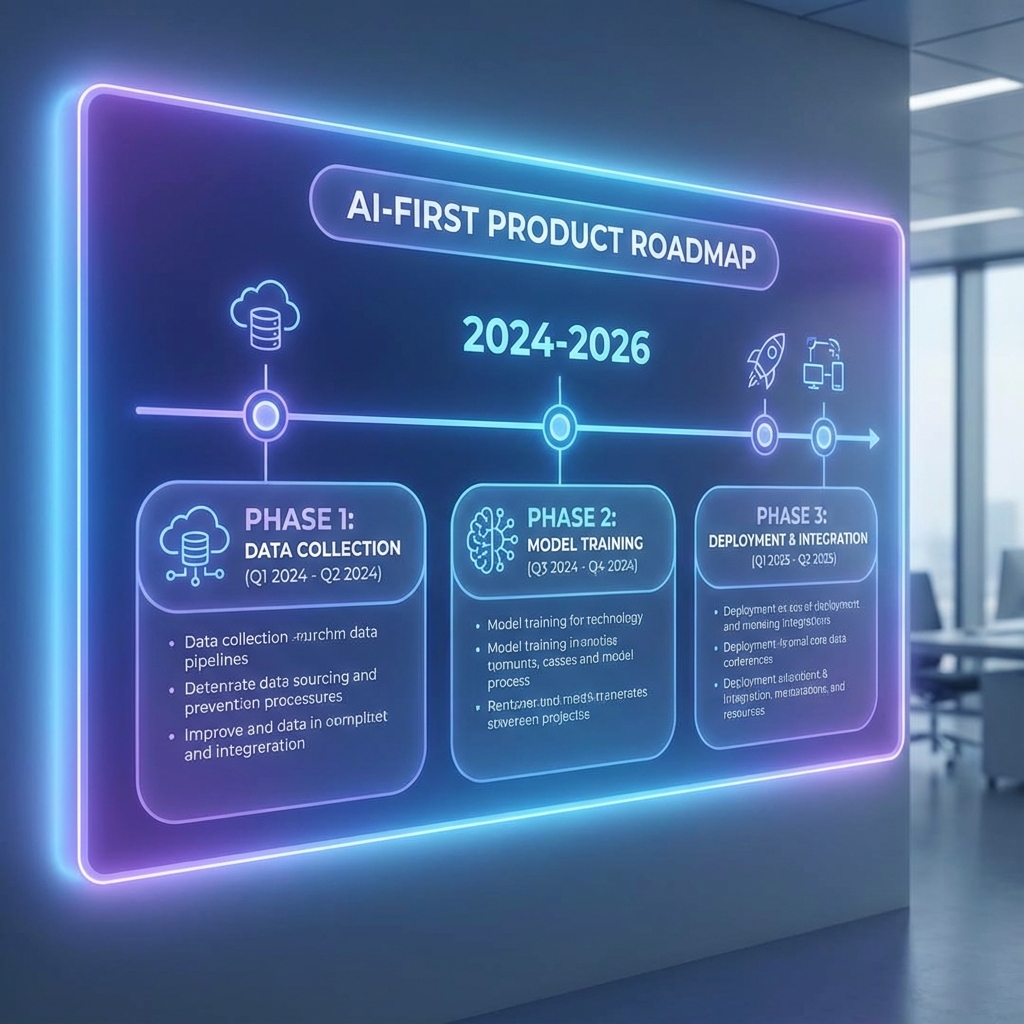
The Core Difference: Probabilistic vs.Deterministic
Traditional software is deterministic.If I click "Save," it saves.If it doesn't, it's a bug.AI software is probabilistic.It might work 90 % of the time.The roadmap needs to account for this uncertainty.You are not building features; you are managing risk.
Phase 1: The Data Infrastructure(The Boring Stuff)
You cannot build AI features without a data strategy.Your Q1 roadmap shouldn't be "Launch Chatbot." It should be "Clean and Vectorize Knowledge Base."
Key Milestones:
- Unification: Breaking down data silos. Your distinct customer support Zendesk tickets need to talk to your Jira engineering tickets.
- Sanitization: Removing PII and low-quality data. Constructing a "Golden Dataset" for testing.
- Vectorization: Implementing a Vector Database (like Pinecone or Weaviate) to give your LLM long-term memory.
Phase 2: The "Eval" Framework(The New QA)
In traditional software, you have "QA." You have unit tests.In AI, you have "Evals."
Before you ship a single prompt to production, you need a way to measure quality programmatically.You cannot rely on "vibes"("It feels better now").
Building an Eval Pipeline:
- Create a dataset of 100 question - answer pairs that represent "Perfect" behavior.
- Run your model against these 100 questions.
- Use a stronger model(like GPT - 4) to grade the answers of your smaller model.
- Track the score over time.
Phase 3: The "Minimum Viable Prediction"(MVP)
Don't try to build "Jarvis" on day one. Start with "Autocomplete."
The Ladder of AI Complexity:
- Level 1: Classification. (e.g., Tag this support ticket as "Billing" or "Technical"). Low risk.
- Level 2: Summarization. (e.g., Summarize this meeting transcript). Medium risk.
- Level 3: Generation. (e.g., Write a draft email response). High risk.
- Level 4: Agentic Action. (e.g., Refund this user). Critical risk.
Your roadmap should climb this ladder.Prove value at Level 1 before attempting Level 4.
Phase 4: The Feedback Loop(RLHF)
The product isn't finished when it ships. That's when training begins.
You need to build UI mechanisms for users to correct the AI.A "Thumbs Up/Down" button is the bare minimum.A "Rewrite this" text box is better.This data becomes your proprietary advantage.OpenAI has the model, but you have the user feedback on how the model performs in your specific domain.
Phase 5: Cost Optimization & Latency
Once you have product - market fit, you need unit - economics fit.
Optimization Strategies:
- Caching: If 20% of users ask the same question, cache the answer. Semantic Caching is a huge win.
- Model Distillation: Use GPT-4 to teach a smaller, cheaper model (like Llama 3) how to do the task.
- Token Optimization: Shortening your system prompts to save money on every call.
The "Buy vs. Build" Decision Matrix
Should you train your own model ? Almost certainly not.Should you fine - tune ? Maybe.Should you RAG(Retrieval Augmented Generation) ? Yes, absolutely.
The Rule of Thumb:
- Use RAG when you need the model to know facts about your business (Knowledge).
- Use Fine - Tuning when you need the model to speak in a specific tone or format (Style).
- Use Pre - Training only if you are Bloomberg or Google (Base Capability).
Conclusion: The "Living" Roadmap
An AI roadmap is not a static PDF to be presented to the board.It is a living hypothesis.You must be willing to pivot based on model updates.When GPT - 5 drops, half your roadmap might become obsolete(or native).The job of the AI PM is to surf this wave, not to build a dam against it.