Modern Frontend Architecture: Server Components, Signals, and The Edge
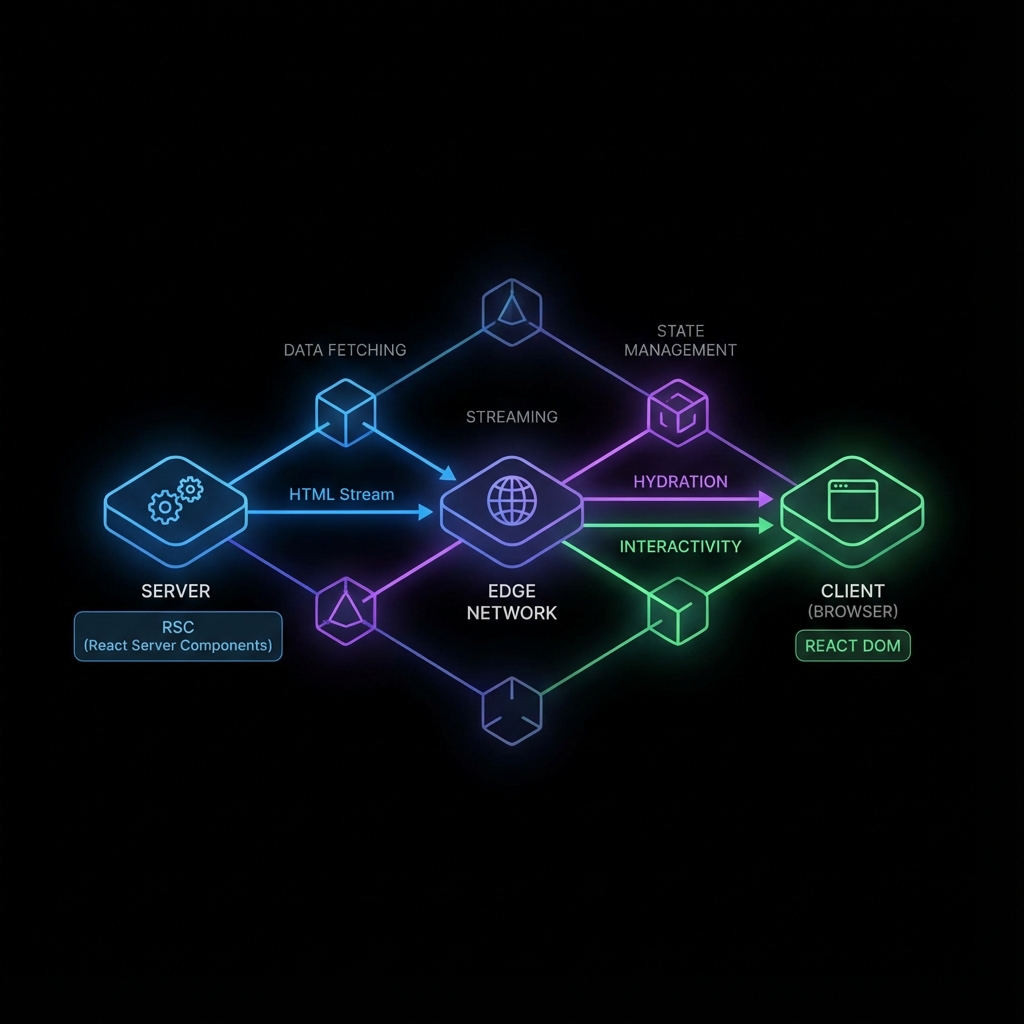
The pendulum of web development is swinging back. For the last decade, we obsessively moved logic from the server to the client. We built massive Single Page Applications (SPAs) that forced users to download megabytes of JavaScript just to render a blog post. We optimized for developer experience (DX) at the expense of user experience (UX). But now, a correction is happening. With the rise of React Server Components (RSC), Islands Architecture, and Resumability, we are entering a new era of "Hybrid" architecture.
1. The Historical Context: How We Got Here
To understand the current shift, we must look at the last 20 years of architectural decisions.
Phase 1: The Multi-Page App (MPA) - 2000-2010
The Stack: LAMP (Linux, Apache, MySQL, PHP), Ruby on Rails, Django.
The Model: The server did everything. When you clicked a link, the browser sent a request, the server queried the database, rendered HTML, and sent it back.
Pros: incredibly fast First Contentful Paint (FCP). Minimal JavaScript on the client.
Cons: The "White Flash" between pages. Every interaction required a full reload. It didn't feel like an "app."
Phase 2: The Single Page App (SPA) - 2010-2020
The Stack: MEAN, MERN, Angular, React, Vue.
The Model: The server sends a blank HTML shell and a massive JS bundle. The browser executes the JS, fetches data (JSON), and renders the UI.
Pros: Fluid transitions. App-like feel. Rich interactivity.
Cons: The "Loading Spinner" hell. Terrible performance on mobile. Poor SEO (initially). Massive bundle sizes (The 3MB JS wall).
Phase 3: The Hybrid Era (SSR + Hydration) - 2016-2022
The Stack: Next.js, Nuxt.
The Model: Server renders HTML (for fast FCP/SEO) -> Browser renders it -> Then JS loads and "hydrates" the HTML to make it interactive.
The Problem: This is the Uncanny Valley. The user sees a button, clicks it, and nothing happens because the main thread is blocked processing the hydration logic. We are effectively doing the work twice: once on the server, once on the client.
2. React Server Components (RSC): The Paradigm Shift
RSC refers to running React components exclusively on the server. This is not SSR. In SSR, the component code is still sent to the client for hydration. In RSC, the component code stays on the server.
The client only receives the serialized UI output (a JSON description of the UI tree).
The Mental Model
// ServerComponent.tsx (Runs on Server)
import db from './database';
import marked from 'marked'; // Huge library, 0kb sent to client

async function BlogPost({ id }) {
  // Direct DB access! No API endpoint needed.
  const post = await db.posts.findById(id);
  const html = marked.parse(post.content);

  return (
    <div>
      <h1>{post.title}</h1>
      <div dangerouslySetInnerHTML={{__html: html}} />
      <LikeButton id={id} /> {/* Client Component included */}
    </div>
  );
}
Key Benefits of RSC:
- Zero Bundle Size: Dependencies used in Server Components (like `marked`, `date - fns`, or database clients) are never sent to the browser.
- Direct Backend Access: You can query your database directly inside your component. No need to build a REST/GraphQL API just to display data.
- Automatic Code Splitting: Client components imported into Server components are automatically lazy-loaded.
3. Islands Architecture (Astro, Fresh)
While React works on component-level granularity, Islands Architecture works on a page-level granularity.
The Concept: Treat the page as static HTML (The Ocean). Embed small, isolated widgets of interactivity (The Islands).
Implementation: Frameworks like Astro ship 0kb of JavaScript by default. If you need a "Buy Button" or a "Carousel", you explicitly mark that component to be hydrated.
---
// BlogPage.astro
import Header from './Header.astro'; // Static (0 JS)
import Carousel from './Carousel.jsx'; // React Component
---
<Header />
<main>
  <h1>Hello World</h1>
  {/* Only this component loads JS */}
  <Carousel client:visible />
</main>
Why this wins: For content-heavy sites (blogs, marketing, e-commerce), 90% of the page is static. Hydrating the entire <body> (React style) is wasteful. Islands ensure you only pay for what you use.
4. Resumability: The Qwik Approach
Hydration is O(n) (complexity grows with components). Resumability is O(1) (constant time).
The Qwik Thesis: Don't hydrate. Resume.
In a standard app, when the app boots, the framework must walk the DOM to attach event listeners. Qwik serializes the event listeners into the HTML itself. The global listener waits for an event (click), then lazily downloads the exact chunk of code needed to handle that click.
This creates "Instant Apps" regardless of size.
5. Signals: Fine-Grained Reactivity
React uses a "Pull" based reactivity model (Virtual DOM Diffing). When state changes, we re-run the component, diff the trees, and patch the DOM.
SolidJS, Preact, and Svelte (Runes) use a "Push" based model (Signals).
The Difference:
// React
function Counter() {
  const [count, setCount] = useState(0);
  console.log("I run every time count changes!");
  return <div>{count}</div>;
}

// SolidJS (Signals)
function Counter() {
  const [count, setCount] = createSignal(0);
  console.log("I run ONLY ONCE at setup!");
  return <div>{count()}</div>;
  // The compiler binds the text node directly to the signal.
}
Signals offer superior performance because they bypass the overhead of the Virtual DOM. React is attempting to mitigate this with the "React Compiler" (formerly React Forget), which auto-memoizes components, but the fundamental VDOM overhead remains.
6. The Edge: Logic at the CDN
Architecture isn't just about how we render, but where we render.
Old World: Origin Server (us-east-1). User in Tokyo waits 200ms latency.
New World: The Edge (Cloudflare Workers, Vercel Edge). Logic runs in a data center 10ms from the user.
This enables "Personalized Static" content. You can run A/B tests, localization, or auth checks at the Edge before the cache is hit.
Conclusion: The Great Convergence
We are seeing a convergence of ideas.
1. Server-First: Move as much logic as possible to back to the server (RSC).
2. Less JS: Ship less JavaScript to the client (Islands, Resumability).
3. Surgical Updates: Update the DOM efficiently (Signals).
The "Modern Frontend" is no longer just a client-side React app. It is a distributed system that intelligently splits logic between the build-time, the edge, the server, and the client. The complexity has increased, but for the user, the web has never been faster.
6. Resumability(Qwik)
Misko Hevery(creator of Angular) created Qwik to solve hydration permanently.
Hydration is O(n) relative to page complexity.
Resumability is O(1) relative to page complexity.
How it works: The framework serializes the state and the event listeners into the HTML.When the page loads, zero JS is executed . Not even a tiny bootstrap script.
It listens for global events.When you click a "Buy" button, Qwik intercepts the click, looks at the HTML attribute on: click="./chunk.js#buyHandler" , and downloads only that specific function.
It's not hydration; it's resuming where the server left off.This enables instant TTI(Time to Interactive) even on massive pages.
7. The Rise of the Meta - Framework
It is almost impossible to build a production - grade React app today without a Meta - Framework(Next.js, Remix).The complexity of rolling your own Webpack config, SSR setup, and routing is too high.
Standardization:
- Routing: File-system based routing (Next.js App Router).
- Data Fetching: Moving from
useEffectto Server Actions / Loaders. - Image Optimization: Automatic resizing and format conversion (WebP/AVIF).
The Blurring Line: Frameworks are becoming full-stack. Action functions in Remix and Server Actions in Next.js allow you to write backend logic directly inside your component file. This reduces context switching but raises questions about separation of concerns.
8. The Edge & Globalization
Backend code is no longer just running on a Node.js server in Virginia(us - east - 1).It's running on the Edge (Cloudflare Workers, Vercel Edge, Deno Deploy).
This brings compute within milliseconds of the user.Your server render happens in London for a user in London, and in Tokyo for a user in Tokyo.
The Challenge: Database Access.
Your code is at the Edge, but your PostgreSQL database is in Virginia.You have just re - introduced latency.Each query has to travel across the ocean.
The Solution:
- HTTP - based DBs: Neon (Serverless Postgres), PlanetScale (Vitess). They handle connection pooling for thousands of lambda instances.
- Distributed Compaction: SQLite at the edge (Turso/LibSQL). The database replicates to the edge nodes.Reads are local and instant.
Conclusion: Choose Your Weapon
We are leaving the era of "Single Page Apps for Everything." We are entering the era of "Hybrid Apps." The server is your friend again.Use it to do the heavy lifting, leave the client for interaction only.
The heuristic for 2024:
- Next.js(App Router): If you are building a complex SaaS, dashboard, or social network. The ecosystem is unbeatable.
- Astro: If you are building a content site, blog, marketing page, or documentation. It is faster by default.
- Remix: If you value web standards, traditional HTTP patterns, and want great mutations (forms).
- Qwik: If you are obsessed with PageSpeed scores on mobile and have a massive e-commerce site.
The "Best Practice" is no longer a specific library, but an architectural pattern: Send less JavaScript.