The AI-Augmented Professional: Working With AI Without Losing Your Edge
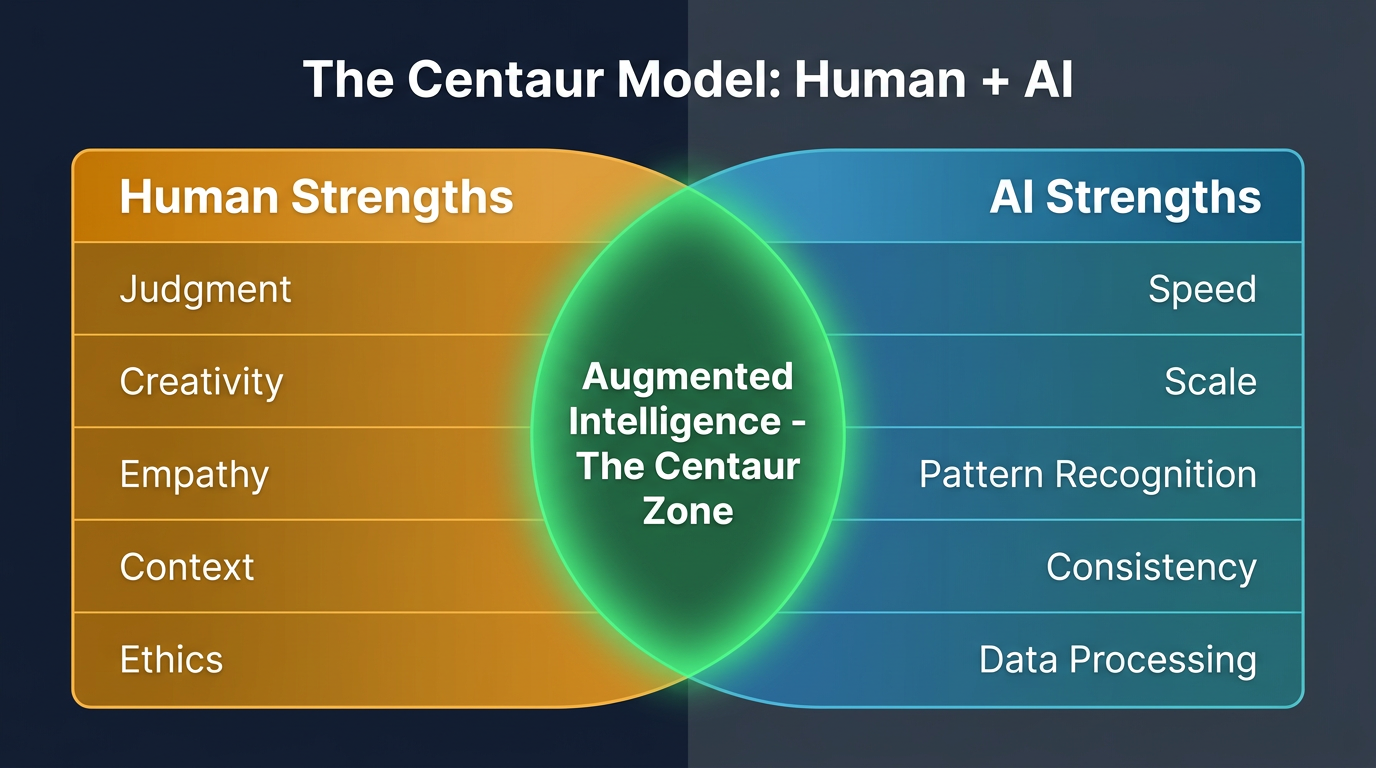
In chess, the era after Deep Blue didn't eliminate human players — it created a new category: the "centaur," a human-computer team that consistently outperformed both pure AI and pure human players. For about a decade, the best chess in the world was played by average humans with excellent AI tools and the wisdom to know when to override the machine. We're living through that same moment in knowledge work. The professionals who thrive won't be those who resist AI or surrender to it. They'll be the centaurs — the ones who develop an almost intuitive sense for when to lean on AI and when to trust their own judgment.

The Dependency Trap
Let's address the elephant in the room: there is a real risk that heavy AI use atrophies your core skills. I've seen it happen.
A writer who uses AI for every first draft slowly loses the ability to stare at a blank page and conjure something from nothing. A developer who uses Copilot for every function gradually forgets how to reason through an algorithm from scratch. An analyst who asks ChatGPT to "find the insight" in every dataset stops developing the intuition that spots anomalies before running the numbers.
This isn't hypothetical. It follows the same pattern as GPS and navigation. Studies show that heavy GPS use reduces hippocampal activity associated with spatial reasoning. The tool that helps you navigate makes you worse at navigating.
"The risk isn't that AI replaces you. The risk is that AI makes you replaceable by making you mediocre — because you stopped exercising the cognitive muscles that made you good in the first place."
The Centaur Model
The solution isn't to avoid AI. That's like avoiding email in 2005 — principled but career-limiting. The solution is the centaur model: a deliberate division of labor between your human capabilities and AI's computational strengths.
The Division of Labor
Think of every task as having four phases:
- Phase 1: Framing. Defining the problem, identifying constraints, determining what "good" looks like. This is human work. AI cannot tell you what problem is worth solving.
- Phase 2: Generating. Producing candidate solutions, drafts, analyses, or options. This is where AI excels. Let it generate quantity while you evaluate quality.
- Phase 3: Evaluating. Assessing the generated options against your criteria, your taste, your understanding of context. This is human work. AI can rank by explicit criteria, but you bring the implicit, unarticulated knowledge of what fits.
- Phase 4: Refining. Polishing the chosen solution, adding nuance, making it work in the real world with real people and real constraints. This is collaborative — AI handles mechanics while you handle judgment.
The centaur doesn't use AI for all four phases. They use AI for Phase 2 (and parts of Phase 4), while keeping Phases 1 and 3 firmly human. This is the critical distinction between AI as leverage and AI as crutch.
The Practice Protocols
Here are concrete protocols I've developed for maintaining genuine expertise while multiplying output with AI.
Protocol 1: The Solo-First Rule
For any task that exercises a skill you want to maintain, always do a first pass without AI. Write the first draft yourself. Sketch the design yourself. Build the initial analysis yourself. Then use AI to improve, expand, or pressure-test your work.
This preserves the cognitive effort that builds and maintains skill. You're not avoiding AI — you're sequencing it. AI becomes your editor, not your ghostwriter.
The exception: purely mechanical tasks where the skill being exercised isn't one you care about maintaining. Formatting data, boilerplate code, administrative emails — let AI handle these entirely.
Protocol 2: The Override Log
Keep a log of every time you override AI's suggestion. When AI generates an analysis and you think it's wrong, or when it suggests an approach and you choose differently, write down why. This practice does three things:
- It forces you to articulate your judgment, which strengthens it.
- It creates a record of where your expertise adds value beyond what AI provides.
- Over time, it reveals patterns — the types of situations where your judgment consistently outperforms AI's suggestions, and vice versa.
Protocol 3: The Deliberate Downgrade
Once a month, do a significant work task with deliberately primitive tools. Write a strategy memo with pen and paper. Analyze data in a spreadsheet without any AI assistance. Code a feature without Copilot. This is the professional equivalent of a runner doing a training session at altitude — temporary discomfort that maintains and strengthens baseline capability.
Protocol 4: The Teaching Test
Can you explain what you produced — in detail, without referencing AI — to a skeptical colleague? If you used AI to generate an analysis, can you defend every assumption, explain every methodology choice, and answer probing questions? If not, you don't understand your own work well enough. Go deeper.
| Level | Description | Signal | Risk |
|---|---|---|---|
| Healthy Leverage | AI amplifies existing skills | Can do the task without AI, just slower | Low |
| Growing Reliance | AI becomes default first step | Uncomfortable starting without AI | Medium |
| Skill Atrophy | Core skills declining | Can't do basic tasks without AI | High |
| Dangerous Dependency | Can't function without AI | AI outage = total work stoppage | Critical |
The Productivity Paradox
Here's the counterintuitive truth: the professionals getting the most value from AI are those who were already highly skilled. AI is a multiplier, not an equalizer.
A senior strategist who uses AI to rapidly test 20 hypotheses produces extraordinary work — because they know which hypotheses to test and how to interpret the results. A junior analyst who uses AI to do the same thing produces noise — because they can't distinguish signal from artifact.
This is the productivity paradox of AI: it amplifies existing capability gaps rather than closing them. The best get better faster. The mediocre get more efficiently mediocre.
The implication is stark: your investment in genuine expertise is more important in the AI age, not less. AI raises the ceiling for skilled professionals while potentially lowering the floor for unskilled ones.
Building Your AI Workflow
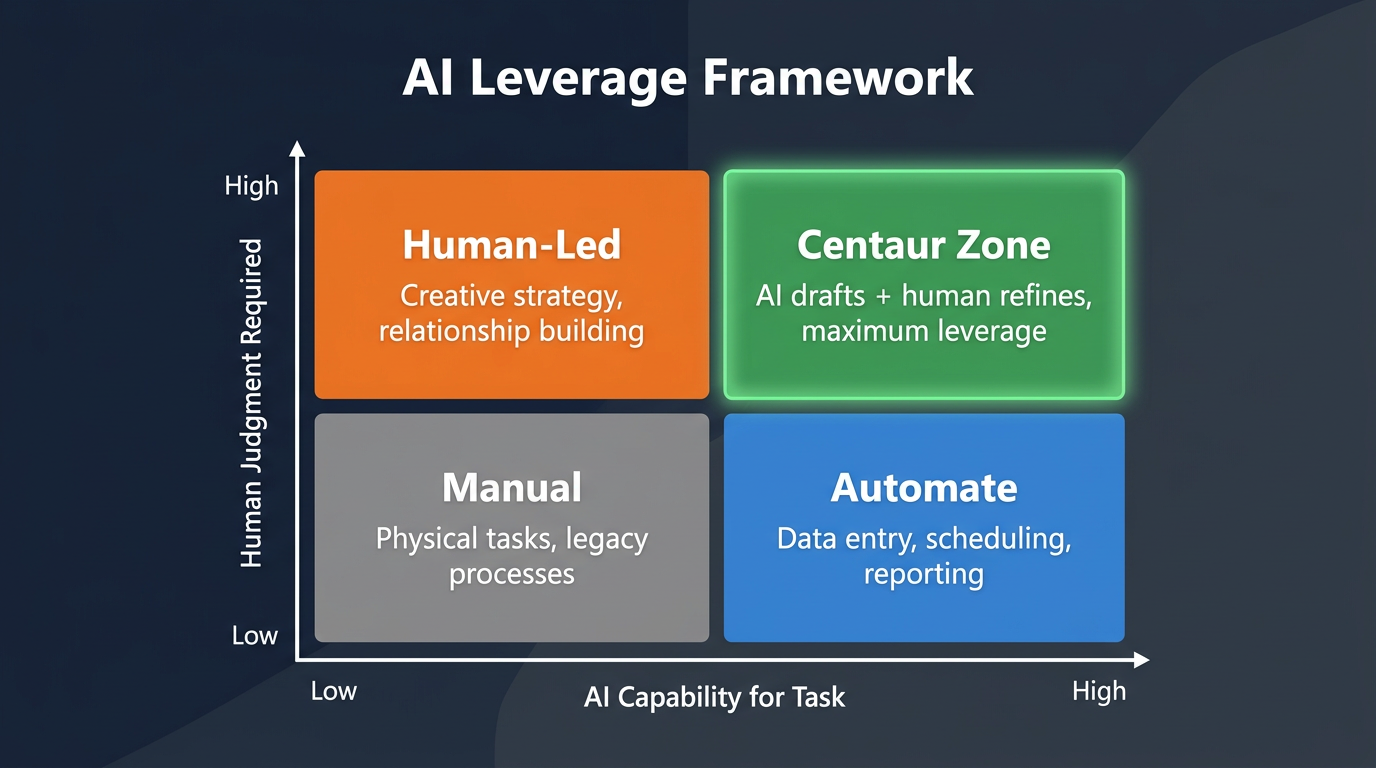
Here's a practical framework for integrating AI into your work without losing your edge:
Category 1: Full Delegation
Tasks where the skill exercised is not core to your professional identity. Examples: email drafting, scheduling, data formatting, boilerplate documentation, meeting summaries. Delegate these entirely to AI. No guilt.
Category 2: AI-Assisted (You Lead)
Tasks that exercise core skills but have a high mechanical component. Examples: research synthesis, first-draft analysis, code implementation after you've designed the architecture, presentation creation after you've outlined the narrative. Do the thinking, let AI do the typing.
Category 3: AI-Challenged (AI Checks You)
Tasks where you want to maintain and sharpen skills. Do them yourself first, then use AI as a reviewer. Examples: strategic recommendations, creative writing, system design, complex negotiations preparation. Ask AI: "Here's my analysis. What am I missing? Where is my reasoning weakest?"
Category 4: Human Only
Tasks where AI involvement would actively harm the outcome. Examples: 1:1 conversations with reports, high-stakes client relationships, ethical decisions, creative ideation for novel problems. Keep AI out of these. The authenticity, empathy, and originality they require are your competitive moat.
Deliberate Downgrade
Once a week, do a key task without AI. Write that email, analyze that data, code that function manually.
Override Log
Track every time you override AI output. These are your judgment moments—the skill you need to preserve.
Expertise Audit
Monthly check: can you still explain your domain without AI? If not, you're losing the skill that makes your AI use valuable.
Teaching Test
Can you teach someone your skill without AI? Teaching is the ultimate test of understanding vs. mere AI delegation.
The Long Game
The centaur era in chess lasted about 15 years before AI became so dominant that human input added negligible value. In knowledge work, I believe the centaur era will last longer — decades, not years — because the tasks are more complex, more context-dependent, and more embedded in human social systems.
But it won't last forever. The professionals who use this era wisely — building irreplaceable human skills while leveraging AI for everything else — will be positioned for whatever comes next. Those who simply coast on AI-boosted productivity without investing in genuine growth will find themselves progressively less differentiated from the AI itself.
Be the centaur. But never forget which half is you.